Imagine placing an NFL wager on Tuesday afternoon when your preferred team is favored by three…
Sports Betting Risk Management: What Bettors Can Learn From Ray Dalio

Most sports bettors spend considerable time trying to determine which team will win, whether a point spread offers value, or if a particular player is likely to exceed a statistical projection. Far fewer spend the same amount of time considering how their individual wagers fit together or what happens when several predictions go wrong. Yet understanding sports betting risk management can be just as important as identifying potentially profitable betting opportunities.
This is where the investment philosophy of Ray Dalio offers an interesting perspective.
Dalio, the founder of Bridgewater Associates, built his reputation around understanding uncertainty, managing exposure, and constructing investment portfolios designed to withstand different economic conditions. Rather than assuming that his predictions would always be correct, his approach emphasized preparing for situations in which they were wrong.
Sports betting and investing are not identical. Investments can represent ownership of productive assets, while sports wagers typically involve a built-in sportsbook margin. Nevertheless, both require decisions involving probability, capital allocation, and uncertainty.
For sports bettors, several of Dalio’s principles provide useful lessons about diversification, bankroll protection, and controlling unnecessary exposure.
The objective is not to turn a sports betting bankroll into an investment portfolio. It is to borrow useful risk-management concepts that can help bettors make more disciplined decisions.
Who Is Ray Dalio, and Why Does His Investment Philosophy Matter?
Ray Dalio founded Bridgewater Associates in 1975 and helped develop it into one of the world’s most prominent investment management firms. Throughout his career, he became known for studying economic cycles, identifying relationships between financial assets, and developing systematic approaches to investment decisions.
One of his best-known investment concepts is the All Weather strategy.
The basic idea behind All Weather is that investors cannot consistently predict which economic environment will emerge next. Economic growth may accelerate or slow, inflation may rise or fall, and financial markets may respond differently to each scenario.
Rather than constructing a portfolio that depends entirely on one economic forecast, the strategy seeks to balance exposure across investments that respond differently to changing conditions.
Another important element of Dalio’s investment philosophy involves understanding how different positions contribute to overall portfolio risk. Owning several investments does not necessarily provide meaningful diversification if those investments respond similarly to the same economic events.
This principle has a direct parallel in sports betting.
A bettor may place wagers on five different games and believe that the risk is spread across several outcomes. However, if those wagers depend on similar conditions, teams, or statistical assumptions, the bettor may have more concentrated exposure than expected.
The important lesson is that diversification should be evaluated by examining the underlying risks, not simply by counting the number of positions.
Lesson 1: Diversification Can Reduce Concentrated Risk
Diversification is one of the most familiar concepts in investing. Rather than placing all available capital into one investment, investors distribute their exposure among different assets.
The purpose is to reduce dependence on a single outcome.
Sports bettors can apply a similar principle when deciding how much of their bankroll to expose to particular teams, leagues, or betting strategies.
Consider a bettor who places five wagers on an NFL game involving the Kansas City Chiefs.
The bettor wagers on the Chiefs moneyline, the Chiefs to cover the spread, their quarterback to exceed his passing yardage projection, a receiver to score a touchdown, and the game’s total to go over.
At first glance, these appear to be five separate wagers.
However, several of them may depend on the same underlying event: the Chiefs having a productive offensive performance.
If the quarterback suffers an injury or the offense struggles unexpectedly, multiple wagers could lose together.
This is an example of correlated betting exposure.
Understanding Correlation Between Sports Bets
Correlation describes the relationship between different outcomes.
Two wagers are positively correlated when the circumstances that help one wager succeed also tend to help the other succeed.
For example, betting on a quarterback to throw for more than 300 yards and betting on his leading receiver to exceed 100 receiving yards may create positive correlation. A particularly productive passing game could benefit both wagers.
Correlation does not mean that both wagers will always win or lose together. It means that their results are not entirely independent.
A bettor can begin evaluating correlated exposure by examining the assumptions behind each wager.
Before placing several bets, consider whether they depend on the same team performing well, the same player remaining healthy, or the same game conditions developing.
If several wagers depend on one underlying prediction, treat them as related exposures when determining how much of the bankroll is at risk.
For example, someone using a $2,000 bankroll might normally risk $20 on an individual wager. However, placing five highly correlated $20 bets could create $100 in total exposure to one game scenario.
That represents 5% of the bankroll.
Although each wager is relatively small, the combined exposure may be considerably larger than intended.
The lesson from Dalio is not that every bettor should wager on multiple sports. It is that diversification requires understanding what actually drives the results.
Spreading wagers across several markets can reduce concentration, but it does not automatically improve profitability.
Lesson 2: Protecting Your Bankroll Is More Important Than Chasing Big Wins
One of the most valuable lessons from professional investing is that avoiding substantial losses matters.
A large loss creates a mathematical disadvantage because recovering the original amount requires a proportionally larger gain.
Consider a bettor who begins with a $2,000 bankroll and loses 50%.
The bankroll falls to $1,000.
To return to the original $2,000, the bettor must earn a 100% return on the remaining money.
This relationship becomes particularly important during prolonged losing streaks.
The following table demonstrates how much a bankroll must increase to recover from different levels of losses.
| Bankroll Loss | Gain Needed to Recover |
| 10% | 11.1% |
| 20% | 25% |
| 30% | 42.9% |
| 40% | 66.7% |
| 50% | 100% |
| 60% | 150% |
Notice how dramatically the required recovery increases as losses become larger.
A bettor who loses 10% of a bankroll needs a relatively modest percentage gain to recover. Someone who loses 50% faces a much more difficult challenge.
This is why sports betting risk management should begin with protecting the amount of money available for future wagers.
Why Smaller Wagers Can Make a Difference
Imagine two bettors who each begin with $2,000.
Bettor A risks 10% of the original bankroll, or $200, on each wager.
Bettor B risks 1%, or $20, on each wager.
Suppose both experience ten consecutive losses, and both use fixed dollar amounts based on their starting bankroll.
Bettor A loses the entire $2,000.
Bettor B loses $200 and retains $1,800.
Both bettors made ten unsuccessful predictions, but their financial outcomes were dramatically different.
The example illustrates the importance of controlling position size.
Smaller wagers do not improve the probability of winning an individual bet. They simply limit how much damage a losing wager can cause.
Bettors should establish a bankroll consisting only of money they can afford to lose without affecting household expenses, savings, or financial obligations.
They should then choose a consistent wagering amount based on that bankroll.
Some bettors use 1% of their bankroll per wager as a conservative starting framework. However, even this approach carries risk, particularly when a bettor places numerous wagers or has no demonstrated betting advantage.
The appropriate amount depends on personal circumstances, the uncertainty of the strategy, and the bettor’s ability to tolerate losses.
Lesson 3: Not All Bets Carry the Same Risk
Dalio’s investment philosophy emphasizes understanding how much risk different positions contribute to an overall portfolio.
This is an important distinction because allocating equal amounts of money to different investments does not necessarily create equal risk exposure.
The same idea applies to sports betting.
A $20 wager on a heavy favorite, a $20 wager on an underdog, and a $20 wager on a five-team parlay all risk the same $20 if they lose.
However, the probabilities of winning, potential payouts, and patterns of returns can differ significantly.
Consider three hypothetical wagers:
| Wager | Odds | Amount Risked | Potential Profit |
| Heavy favorite | -300 | $20 | $6.67 |
| Even-money wager | +100 | $20 | $20 |
| Underdog | +300 | $20 | $60 |
Each wager carries a maximum loss of $20.
However, the underdog must win less frequently to produce the same expected profitability as a favorite, assuming the odds accurately reflect the bettor’s opportunities.
For a wager at +300, the break-even win probability is 25%.
At -300, the break-even win probability is 75%.
These break-even percentages do not establish whether either wager is attractive. The bettor must compare the offered odds with a reasonable estimate of the outcome’s actual probability.
Understanding Risk Beyond the Amount Wagered
A useful way to evaluate betting risk is to examine three separate characteristics.
First, consider the maximum amount that can be lost. For an ordinary fixed-odds wager, this is generally the amount risked.
Second, examine the probability of losing. A large underdog may offer an attractive payout but will generally lose more frequently than a substantial favorite.
Third, consider how the wager relates to other active bets.
A bettor who has already placed several wagers on one team’s success may increase concentration by adding another bet dependent on that team.
Parlays introduce another consideration.
Because every selection must generally win for a standard parlay to succeed, parlays often produce less frequent winning tickets than comparable individual wagers. The larger potential payout can make them appealing, but bettors should understand the lower probability of success and the sportsbook’s pricing.
The objective is not to avoid underdogs, favorites, or parlays automatically. It is to understand the probability, payout, expected value, and combined exposure before committing money.
Lesson 4: Avoid Putting Too Much Confidence in One Prediction
Successful investing requires acknowledging uncertainty.
Even an experienced investor can make an incorrect forecast because unexpected events change the conditions that originally supported a decision.
Sports betting presents the same challenge.
A bettor may spend several hours researching an NFL matchup and conclude that one team has a substantial advantage.
The analysis might include offensive efficiency, defensive performance, injuries, coaching tendencies, weather conditions, and recent results.
The research may be thorough, but the outcome remains uncertain.
A favored quarterback could suffer an early injury. A team might commit several turnovers. A missed field goal or unusual officiating decision could change the result.
None of these possibilities necessarily means the original analysis was poor.
They illustrate the difference between identifying a favorable probability and predicting a guaranteed outcome.
Confidence Should Not Replace Probability
Suppose a bettor estimates that a particular team has a 60% chance of winning.
That still means the bettor expects the team to lose approximately 40% of the time under similar circumstances.
Even if the estimate is accurate, losing the wager would not be surprising.
Problems develop when bettors confuse confidence with certainty.
A bettor might describe a wager as a guaranteed winner and increase the stake to 10% or 15% of the bankroll.
That decision creates substantial exposure to an outcome that remains uncertain.
A better approach is to establish a wagering limit before evaluating the day’s games.
For example, someone who normally risks $20 per wager could maintain that amount rather than dramatically increasing it whenever a selection feels particularly attractive.
More advanced bettors may eventually consider probability-based staking systems, but these require reliable estimates of their actual betting advantage. Inaccurate probability estimates can lead to excessive wagers.
Dalio’s broader lesson is that uncertainty should be incorporated into the decision-making process rather than ignored.
Lesson 5: Build a Betting Portfolio That Can Withstand Losing Streaks
Every sports bettor experiences losing streaks.
Even strategies with a genuine mathematical advantage can produce extended periods of disappointing results.
This happens because individual outcomes are uncertain, and favorable probabilities do not guarantee short-term success.
For example, a bettor with a true 55% probability of winning each independent wager still has a 45% probability of losing any individual bet.
Losing several wagers consecutively remains possible.
A structured bankroll plan helps reduce the financial consequences of these inevitable fluctuations.
A Practical Example Using a $2,000 Bankroll
Consider a hypothetical bettor who sets aside $2,000 specifically for sports betting.
The bettor decides to use a flat-staking approach, risking $20 per wager.
This represents 1% of the original bankroll.
The bettor also establishes a personal limit on total outstanding exposure.
For example, the bettor might decide not to have more than $100 at risk across unsettled wagers at one time.
This 5% exposure limit is an illustrative personal rule, not a scientifically established optimal amount.
To implement a similar approach, a bettor can follow a consistent process.
Establish a separate bankroll. Decide how much money can be lost without affecting essential expenses. Keep this money separate from funds needed for bills, emergencies, or other financial priorities.
Choose a standard wagering amount. Select a fixed percentage of the bankroll, such as 1%, and calculate the corresponding dollar amount. For a $2,000 bankroll, that would be $20.
Monitor total open exposure. Before placing another wager, add together the stakes on all unsettled bets. Include correlated wagers when assessing whether too much money depends on one outcome.
Record every wager. Maintain a spreadsheet containing the date, sport, market, odds, amount risked, result, and profit or loss. This makes it possible to evaluate performance over time rather than relying on memory.
Review the bankroll periodically. Recalculate the standard wagering amount at predetermined intervals, such as monthly, rather than increasing stakes impulsively after wins or losses.
The purpose of these guidelines is to create consistency.
A bettor who follows a documented process can more easily identify whether poor results come from normal variance, an ineffective strategy, or excessive risk-taking.

Why Losing Streaks Should Be Expected
Consider a bettor who wins 55% of wagers over a sufficiently large sample.
That bettor still loses 45% of the time.
The probability of losing five consecutive independent wagers at any particular starting point is:
0.45 × 0.45 × 0.45 × 0.45 × 0.45 = 0.01845
That is approximately 1.85%.
Although this probability may appear small, there are many opportunities for such a streak to occur across hundreds of wagers.
The likelihood of encountering at least one five-game losing streak over a long betting history is considerably greater than the probability of losing one specific sequence of five bets.
This is why bankroll plans should account for unfavorable sequences before they occur.
Bettors interested in examining these probabilities can use the Losing Streak Probability Calculator at CoreSportsBetting.com to explore how losing streaks may develop under different assumptions.
Lesson 6: Diversification Is Useless Without a Betting Edge
Diversification can help control concentrated exposure, but there is an important limitation that sports bettors must understand.
Diversification does not automatically make a losing betting strategy profitable.
This is one of the most important differences between applying investment concepts and developing a sports betting strategy.
In financial markets, diversified portfolios may benefit from long-term returns generated by productive businesses, bonds, and other assets.
Sports betting operates differently.
Sportsbooks generally incorporate a margin into their odds, meaning bettors must overcome the cost of that margin to achieve positive expected returns.
Consider a standard point spread wager priced at -110.
A bettor risks $110 to earn $100 in profit.
To break even over the long run at those odds, the bettor needs to win approximately 52.38% of wagers.
A bettor who wins only 50% of wagers at -110 odds will lose money over time.
For example, imagine placing 100 wagers at $110 each.
If 50 win and 50 lose, the results would be:
| Result | Amount |
| Profit from 50 wins | +$5,000 |
| Loss from 50 defeats | -$5,500 |
| Net result | -$500 |
The bettor finishes with a $500 loss despite winning half of the wagers.
Now suppose those 100 bets are distributed equally among NFL, NBA, MLB, and NHL games.
The bettor has diversified across four sports.
However, if the bettor continues to win only 50% at -110 odds, the mathematical disadvantage remains.
The diversification may change the pattern of wins and losses, depending on correlations between the wagers, but it does not eliminate the negative expected value.
Expected Value Must Come First
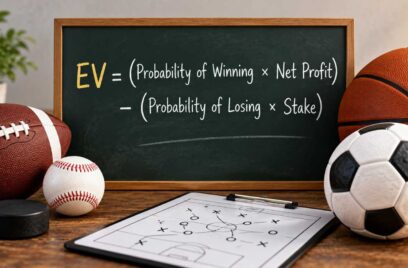
Expected value measures the average amount a wager is expected to win or lose based on its probability of success and potential payout.
For a $110 wager at -110 odds, suppose the bettor estimates a 55% probability of winning.
The expected value is:
(0.55 × $100) − (0.45 × $110)
= $55 − $49.50
= +$5.50
Under those assumptions, the wager has an expected profit of $5.50 for every $110 risked.
However, this positive expected value depends entirely on the 55% probability estimate being accurate.
If the actual win probability is lower, the expected value changes.
This distinction matters because a bettor can manage bankroll exposure perfectly and still lose money over the long run if the wagers consistently have negative expected value.
Effective sports betting risk management therefore involves two separate responsibilities: evaluating whether a wager offers value and controlling how much money is exposed to that wager.
Both matter, but neither can substitute for the other.
Lesson 7: Evaluate Your Entire Betting Strategy, Not Just Individual Results
Another useful lesson from systematic investing is the importance of evaluating performance over time.
Investors generally do not judge an entire portfolio based on whether one position gained or lost money yesterday.
They examine performance across different investments, market conditions, and periods.
Sports bettors can benefit from a similar approach.
A single winning wager does not prove that a betting strategy is profitable.
Likewise, one losing wager does not establish that a decision was incorrect.
The more meaningful question is whether the bettor consistently identifies wagers with favorable expected value and manages exposure responsibly.
What Should Bettors Track?
A detailed betting record should include more than wins and losses.
For each wager, record the sport, betting market, selection, odds, stake, result, and net profit or loss.
Also consider recording the opening odds, the price obtained when placing the bet, and the closing odds shortly before the event begins.
These details can help identify whether the bettor regularly obtains favorable prices relative to the market’s closing numbers.
This concept is commonly called closing line value.
For example, a bettor who consistently places wagers at -110 that later close at -125 may be obtaining more favorable prices than bettors entering at the closing number.
That does not guarantee profitability, but it provides additional information when evaluating the quality of the betting process.
Bettors should also examine results by sport and strategy.
Someone might discover that an NFL betting approach has performed reasonably well while an NBA strategy has consistently produced losses.
Rather than assuming that betting on more sports creates a stronger portfolio, the bettor can investigate whether each approach has demonstrated a credible advantage.
Small samples can be misleading, so results should be interpreted cautiously.
A strategy that wins 12 of its first 20 wagers may simply have benefited from favorable variance.
Consistent tracking over larger samples provides a more useful foundation for evaluating performance.
How to Apply Ray Dalio’s Principles to Your Sports Betting Strategy
Dalio’s philosophy offers several practical lessons, but applying them does not require a complicated betting system.
The objective is to establish a repeatable process that considers both the potential value of a wager and the risks associated with placing it.
A useful starting point is to review the following questions before committing money.
Does the wager offer a reasonable mathematical advantage? Compare the sportsbook’s odds with your estimated probability of success. If you cannot identify a credible reason why the offered price may be favorable, consider passing on the wager.
How much of the bankroll will this wager expose? Calculate the stake as a percentage of the bankroll. Avoid increasing the amount simply because a wager feels unusually certain.
Are there already similar wagers outstanding? Review existing bets to determine whether several depend on the same team, player, game conditions, or underlying prediction.
Can the bankroll withstand an extended losing streak? Consider how ten or more consecutive losses would affect available funds. If that scenario would create financial pressure, the standard wagering amount may be too large.
Am I following a documented strategy? Record the reasoning behind each wager and evaluate results over time. Avoid changing strategies simply because of a few disappointing outcomes.
These questions encourage bettors to evaluate their decisions as part of a larger process rather than treating each wager as an isolated opportunity.
They also help establish a distinction between making a potentially profitable wager and taking an unnecessary financial risk.
Even a wager with positive expected value can be a poor decision if the amount risked is excessive relative to the bankroll.
Conclusion: Think About Risk Before Thinking About Profit
Ray Dalio’s investment philosophy offers sports bettors a valuable reminder: successful decision-making requires more than predicting what will happen next.
Diversification can reduce dependence on individual outcomes, but only when the underlying exposures are genuinely different. Bankroll preservation helps bettors withstand unfavorable periods, while consistent staking limits the damage caused by incorrect predictions.
Perhaps most importantly, understanding risk means accepting that even well-researched decisions can produce losses.
Effective sports betting risk management combines realistic probability estimates, disciplined wager sizing, awareness of correlated exposure, and a willingness to evaluate results over time.
However, none of these principles eliminates the sportsbook’s margin or guarantees profitability. Bettors still need a genuine mathematical advantage to have a positive long-term expectation.
The most useful lesson from Dalio is not to copy his investment strategies directly. It is to adopt the discipline of considering what could go wrong before deciding how much money to commit.
Sports bettors cannot control the final score, unexpected injuries, or the unpredictable events that determine individual games.
They can control which wagers they make, the prices they accept, and how much of their bankroll they are willing to risk.
And those decisions deserve just as much attention as the predictions themselves.
Before You Go…
Get Weekly Winning Angles Delivered to You
Enjoy this article? Join the Core Sports Betting newsletter where we break down actionable strategies, betting angles, and real-game insights.
Some of the concepts we touch on each week can evolve into full handicapping systems – the kind you can test, refine, and potentially build into long-term edges.
Simple. Practical. No fluff.
Proven Sports Betting Courses
Looking to go deeper?
Our step-by-step courses are built around structured systems – not guesses or opinions. Each course has been backtested over a minimum of 10 years, giving you a clear understanding of how the strategy has performed over time.
If you’re serious about improving your process, these courses show you exactly how to approach betting with discipline and structure.
Free Betting Calculators to Sharpen Your Edge
Want to make smarter, faster decisions?
Our free tools help you quickly calculate odds, payouts, and true value — without the guesswork.
Try these popular calculators:
- Moneyline Calculator
- Parlay Calculator
- No-Vig Odds Calculator (Find True Odds)
- Kelly Criterion Calculator
→ Visit the Betting Tools Hub to access all calculators
Like this article? Pin it on Pinterest!


More to Explore