Golf tournaments present bettors with a challenge that is different from many other sports. The playing…
How to Know If a Moneyline Bet Is Worth It (Using Your Win Percentage)
One of the most common mistakes in sports betting is focusing only on picking winners instead of understanding the price being paid for those winners. Many bettors believe that if they can win more than half of their bets, they will automatically be profitable. In reality, that is not always true. The odds attached to each wager play a major role in determining long-term success. If you have ever wondered how to know if a moneyline bet is worth it, the answer comes down to comparing your win percentage to the price you are laying.
This is where a structured approach becomes extremely valuable. By understanding how your historical performance aligns with sportsbook odds, you can quickly determine whether a bet offers value or is simply too expensive. The goal is not just to win bets, but to make sure each wager is placed at a price that allows for long-term profitability.
Why Most Bettors Lose Even When They Win
At first glance, it seems logical that winning more bets than you lose should lead to profit. However, this assumption overlooks one critical factor: the cost of each bet. Sportsbooks build their advantage into the odds, and when bettors consistently lay high prices, that cost adds up quickly.
To understand this concept clearly, it helps to think about what happens over a large sample of bets. Imagine a bettor who wins 55% of their wagers. On paper, that looks like a strong performance. But if most of those bets are placed at -180 or -200 odds, the required win rate to break even is much higher than 55%. Over time, the bettor may still lose money despite having a winning record.
This is why price matters just as much as picking the right side. A bettor who understands value can win less frequently but still be profitable, while someone who ignores pricing can win often and still fall behind.
What a Moneyline Really Represents
Before evaluating whether a bet is worth placing, it is important to understand what moneyline odds actually mean. Moneyline odds are not just numbers on a screen; they represent the sportsbook’s estimate of a team’s chances of winning, along with built-in margin.
Positive odds, such as +120 or +150, indicate underdogs. These numbers show how much profit you would earn on a $100 wager. Negative odds, such as -130 or -200, indicate favorites. These numbers show how much you must risk to win $100.
Each of these odds also corresponds to an implied probability. For example, odds of -150 suggest that the team has roughly a 60% chance of winning, while +120 implies closer to a 45% chance.
If you want to convert these odds into percentages quickly, you can also use our moneyline calculator here.
Once you understand that every moneyline reflects an expected win rate, you can begin comparing that expectation to your own results. This comparison is the key step in learning how to know if a moneyline bet is worth it.
Break-Even Win Percentage Explained
Every moneyline has a break-even point, which is the win percentage required to avoid losing money over time. If your actual win rate is higher than this number, the bet may offer value. If it is lower, the bet is likely too expensive.
To make this concept easier to understand, consider a few common examples. A moneyline of -110 requires a win rate of about 52.38% to break even. A line of -130 requires about 56.52%. A heavier favorite at -200 requires 66.67%.
These numbers highlight an important reality. As the odds become more expensive, the required win rate increases significantly. This means that even a small difference in price can have a large impact on long-term profitability.
When you compare your own win percentage to these break-even points, you begin to see which bets align with your performance and which do not.
Using Your Season Win Percentage as Your Edge
Tracking your season win percentage is one of the most valuable habits you can develop as a bettor. It provides a real measure of your performance and serves as a baseline for evaluating future bets.
It is important to use a consistent timeframe, such as results through the end of the previous day. This ensures that your decision-making is based on completed data rather than ongoing results. Your win percentage becomes your working estimate of how often you can expect to win under your current approach.
For example, if you have won 57 out of 100 bets, your win rate is 57%. That number can now be used as a benchmark when evaluating new wagers.
The Concept of a Fair Moneyline
Once you know your win percentage, you can take the next step by converting it into a fair moneyline. This represents the most expensive price you can pay while still breaking even.
For example, a win rate of around 57% translates to a fair moneyline in the range of approximately -133 to -136. This means that any bet priced better than that range may offer value, while anything more expensive is likely not worth it.
This concept simplifies decision-making. Instead of analyzing each bet from scratch, you now have a clear cutoff point.
Real Example Using the Calculator
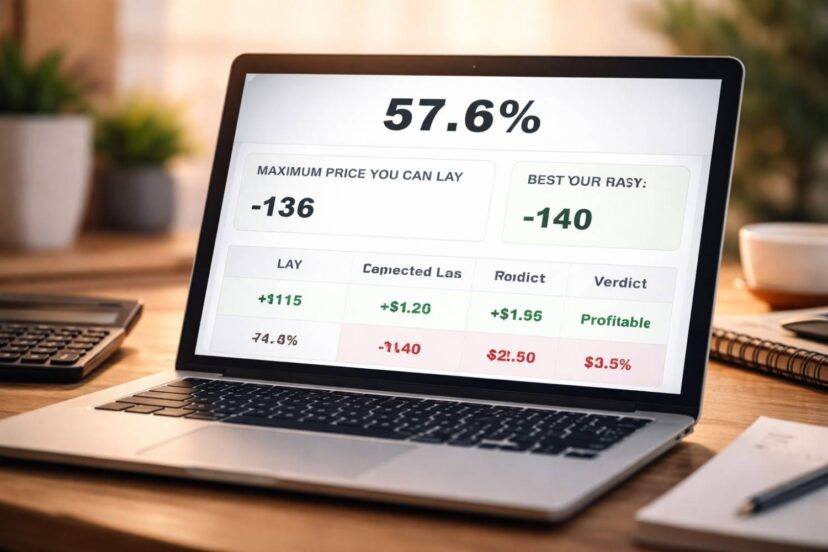
To see how this works in a real scenario, consider a bettor with a 57.63% win rate. Based on that performance, their fair moneyline is approximately -136.
Now imagine they are evaluating three possible wagers:
- +110
- -130
- -290
Try this exact example in the Winning Percentage vs Moneyline Calculator here.
The +110 bet requires a break-even win rate of about 47.62%, which is well below the bettor’s 57.63% rate. This creates a strong edge. The -130 bet requires about 56.52%, which is slightly below the bettor’s win rate, making it a reasonable option with a small edge.
The -290 bet, however, requires a win rate of over 74%, which is far above the bettor’s actual performance. This means the price is too expensive, even if the team appears likely to win.
This example clearly shows how to know if a moneyline bet is worth it in practical terms.
Why Betting Big Favorites Can Hurt Your Results
Many bettors are drawn to large favorites because they feel safer. A team priced at -250 or -300 is expected to win most of the time, and that can create a sense of confidence. However, the math behind these bets tells a different story.
When you bet large favorites, you are risking a significant amount to win a relatively small profit. If one of those bets loses, it can erase the gains from several previous wins. Over time, this imbalance makes it difficult to stay profitable unless your win rate is extremely high.

How to Use This Strategy Daily
Applying this approach consistently requires a structured routine. Rather than making decisions based on instinct, you can follow a repeatable process that keeps your betting aligned with your edge.
Start by tracking your results and calculating your current win percentage. Then convert that win percentage into a fair moneyline. Finally, compare that number to the available betting lines.
You can run this full process in seconds using the Winning Percentage vs Moneyline Calculator here.
The goal is not to bet more often, but to bet more selectively. By focusing only on wagers that meet your criteria, you give yourself a better chance of long-term success.
Common Mistakes to Avoid
Even with a strong framework, there are a few common mistakes that can reduce the effectiveness of this strategy. Being aware of these pitfalls can help you stay on track.
One mistake is relying on a small sample size. Another is assuming that past performance guarantees future results. Many bettors also fall into the trap of consistently betting large favorites simply because they appear safer.
Avoiding these habits will make your use of the calculator much more effective.
How This Leads to Long-Term Profitability
The true value of this strategy becomes clear over time. By consistently placing bets where your win rate exceeds the break-even requirement, you create a positive expectation. Even if individual results vary, the overall trend should move in your favor.
Conclusion
Understanding pricing is one of the most important skills in sports betting. Winning games is only part of the equation; the odds you accept determine whether those wins translate into profit. Once you understand how to know if a moneyline bet is worth it, you begin to approach betting in a more structured and effective way.
Before You Go…
Get Weekly Winning Angles Delivered to You
Enjoy this article? Join the Core Sports Betting newsletter where we break down actionable strategies, betting angles, and real-game insights.
Some of the concepts we touch on each week can evolve into full handicapping systems – the kind you can test, refine, and potentially build into long-term edges.
Simple. Practical. No fluff.
Proven Sports Betting Courses
Looking to go deeper?
Our step-by-step courses are built around structured systems – not guesses or opinions. Each course has been backtested over a minimum of 10 years, giving you a clear understanding of how the strategy has performed over time.
If you’re serious about improving your process, these courses show you exactly how to approach betting with discipline and structure.
Free Betting Calculators to Sharpen Your Edge
Want to make smarter, faster decisions?
Our free tools help you quickly calculate odds, payouts, and true value — without the guesswork.
Try these popular calculators:
- Moneyline Calculator
- Parlay Calculator
- No-Vig Odds Calculator (Find True Odds)
- Kelly Criterion Calculator
→ Visit the Betting Tools Hub to access all calculators
Like this article? Pin it on Pinterest!


More to Explore