Winning a sports bet feels great, but winning individual wagers is not necessarily the same as…
Closing Line Movement: What It Can – and Cannot – Tell You About a Sports Bet

Imagine placing an NFL wager on Tuesday afternoon when your preferred team is favored by three points. By Sunday morning, that same team is favored by five points. You secured a better number than someone placing the identical wager just before kickoff. Does that mean you made a good bet? Does it suggest that other bettors agree with your assessment? More importantly, does it increase your chances of winning? Understanding closing line movement can help answer some of these questions, but the information is not always as straightforward as it appears.
Sports betting markets constantly adjust as new information becomes available, wagers are placed, and sportsbooks reconsider their prices. These adjustments can provide valuable insight into how the market evaluates a particular matchup. However, interpreting those changes requires more than simply identifying which team attracted movement.
For bettors interested in improving their decision-making, understanding what the closing line represents, why it changes, and how to evaluate those changes can be an important part of developing a more disciplined approach.
What Is Closing Line Movement in Sports Betting?
Every sports betting market has a price that changes over time. When a sportsbook first offers odds on an upcoming event, those initial numbers are commonly called opening lines. As the event approaches, the sportsbook may adjust those numbers in response to new information, betting activity, or changes at competing sportsbooks.
The final available betting line before the market closes is generally referred to as the closing line. For pregame markets, this is usually the last price available before the event begins.
The difference between an earlier line and the closing line represents the movement that occurred during that period.
Consider an NFL matchup where the Philadelphia Eagles open as three-point favorites against the Dallas Cowboys. Over the following several days, the Eagles move to four-point favorites before eventually closing at five-point favorites.
A bettor who wagered on Philadelphia at -3 obtained a more favorable point spread than someone who waited until the line reached -5.
The distinction matters because the first bettor needs Philadelphia to win by more than three points to cover, while the second bettor needs Philadelphia to win by more than five points. A four-point Philadelphia victory would win the first wager but lose the second.
Line movement is not limited to point spreads. Moneyline odds and game totals also change as sportsbooks update their prices.
For example, an MLB underdog might open at +150 and close at +125. Similarly, an NBA game total might open at 228.5 points before closing at 225.5.
In each situation, the market has changed its assessment or pricing of the available betting options. Understanding why that happened is the next important step.
Why Do Sports Betting Lines Move?
Sportsbooks establish opening odds using statistical models, historical performance, matchup information, and other available data. However, an opening line is not a permanent prediction. It is a price that can change as the market develops.
Several factors can influence those adjustments, and multiple factors may contribute to the same movement.
Injuries and Lineup Changes
Player availability is one of the most recognizable reasons for a betting line to change.
Suppose an NBA team opens as a four-point favorite. Two days later, its leading scorer is ruled out because of an injury. The sportsbook may respond by reducing the team’s advantage, perhaps moving the spread from -4 to -1.5.
The size of the adjustment depends on the player’s importance, available replacements, the opponent, and how much of the injury risk was already reflected in the original line.
The same principle applies to an NFL quarterback, an MLB starting pitcher, or an NHL goaltender.
However, bettors should recognize that injury information does not always cause immediate or predictable movement. Sometimes the market has already anticipated a player’s absence, meaning the announcement itself produces little additional adjustment.
Professional Betting Activity
Some bettors use statistical models, detailed matchup analysis, and extensive market research to identify prices they believe are inaccurate.
When sportsbooks receive influential wagers from accounts with a history of identifying favorable prices, they may adjust their odds.
For example, a sportsbook might open an NFL total at 47.5 points. If respected bettors repeatedly wager on the Under, the sportsbook may lower the total to 46.5 or 45.5.
However, an important distinction exists between observing a line change and knowing who caused it.
A bettor looking at an odds screen generally cannot determine whether the movement resulted from professional betting activity, a sportsbook following another market, or newly available information.
The movement itself does not identify the source.
Public Betting Activity
Popular teams and high-profile events frequently attract substantial recreational betting activity.
An NFL team with a large national following may receive considerable attention during a nationally televised matchup. Sportsbooks may adjust prices in response to that demand, although the relationship between betting volume and line movement is not always direct.
A sportsbook does not necessarily need equal amounts wagered on both sides of every event. Its pricing decisions may also reflect risk management, customer behavior, and its assessment of the underlying probabilities.
Therefore, a heavily bet team does not automatically experience movement in its favor.
Weather and Other Developments
Weather can influence betting markets, particularly in outdoor sports.
Strong winds may affect passing and kicking conditions in football, while weather forecasts can influence expectations for scoring in baseball.
Other developments, such as travel disruptions, unexpected lineup decisions, or changes in player availability, can also influence market prices.
The important lesson is that a changing line may reflect legitimate new information rather than a simple preference for one team.
What Closing Line Movement Can Tell You
Although betting line changes cannot predict individual results with certainty, they can provide meaningful information about how a market developed.
The most useful insights generally involve changes in market expectations, the quality of the price a bettor obtained, and patterns that emerge across numerous wagers.
How the Market’s Assessment Changed
A closing line represents the market’s final available price before an event begins.
If an NFL team opens at -2.5 and closes at -4.5, the market has become more favorable toward that team relative to its opponent, at least as reflected in the point spread.
This does not necessarily mean the team has become objectively stronger. Instead, the price now reflects information and betting activity incorporated after the opening number was established.
A bettor can use that change as a starting point for further investigation.
For example, did an important player return from injury? Did weather expectations change? Was the opening number substantially different from prices at competing sportsbooks?
Understanding the reason behind a change is generally more informative than observing the change alone.
Whether You Obtained a Favorable Number
One of the clearest uses of historical betting lines is comparing the number you received with the eventual closing price.
Suppose you wagered on an NFL favorite at -3, and the market closed at -4.5.
Your wager has an advantage over an otherwise identical wager placed at -4.5 because your team has a smaller margin to cover.
This is particularly important around common football margins such as three and seven points.
A bettor holding -3 rather than -3.5, for example, can receive a push if the favorite wins by exactly three points, while the bettor holding -3.5 loses.
Even relatively small differences in betting lines can affect long-term results.
Whether Your Betting Process Deserves Further Evaluation
Consistently obtaining favorable prices relative to a reliable closing market may indicate that your handicapping process is identifying opportunities before they disappear.
Suppose you record 150 wagers over several months and discover that a substantial majority were placed at prices more favorable than the eventual closing odds.
That pattern deserves attention.
It may suggest that your selections, timing, or market comparisons are helping you identify advantageous numbers.
However, it does not establish that your betting strategy is profitable. The strength of the evidence depends on the markets involved, the size of the price differences, the quality of the closing reference, and the number of observations.
A few favorable movements are interesting. A consistent pattern across a large, well-documented sample is considerably more useful.
What Closing Line Movement Cannot Tell You
Understanding the limitations of betting line changes is just as important as understanding their potential benefits.
Many bettors interpret movement as confirmation that their selection is correct. Others assume that a line moving in one direction reveals where the most knowledgeable bettors are placing their money.
Neither conclusion is necessarily justified.
It Cannot Guarantee a Winning Wager
Consider an NFL team that opens as a three-point favorite and closes as a six-point favorite.
A bettor holding -3 received a considerably better number than someone betting at -6.
However, the favorite could still lose the game outright.
Sports outcomes involve uncertainty. Injuries during a game, turnovers, unusual performances, and ordinary randomness can produce results that differ substantially from market expectations.
Obtaining a favorable price is not the same as predicting the winner correctly.
A wager can lose despite having been placed at an attractive number.
It Cannot Prove Who Influenced the Market
When a line moves significantly, bettors sometimes assume that highly informed wagers must be responsible.
That explanation may be correct in certain situations, but the movement alone cannot establish it.
An NFL spread might change because of an injury report, a large wager, updated weather information, or adjustments made by other sportsbooks.
In many cases, several factors operate simultaneously.
Without reliable information about the underlying activity, attributing a line change to a particular group of bettors is speculation.
This is also why reverse line movement should be interpreted cautiously.
Reverse line movement generally describes a situation in which the betting line moves against the side reportedly receiving the majority of public bets.
Although this can be interesting, public betting percentages may represent different sportsbooks, limited customer samples, or ticket counts rather than total dollars wagered.
The information does not automatically reveal the market’s most informed participants.
It Cannot Prove the Closing Line Is Correct
Closing prices often incorporate substantial information, particularly in popular and liquid betting markets.
However, sportsbooks and bettors can still make mistakes.
A market may overreact to an injury announcement, underestimate a replacement player’s abilities, or misjudge how particular conditions will affect a matchup.
Less popular sports and smaller betting markets may also have lower limits and fewer participants, potentially making their prices less reliable.
The closing line is therefore a useful benchmark, not an unquestionable statement of the true probability of an outcome.
It Cannot Automatically Establish Positive Expected Value
A bettor who consistently receives favorable closing prices may be doing something worthwhile, but favorable movement alone does not prove that every wager has positive expected value.
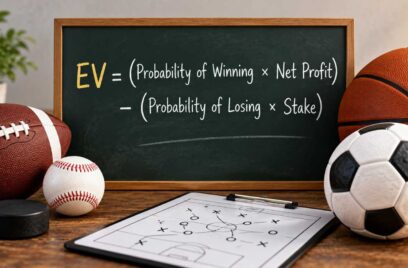
Expected value depends on the relationship between the odds offered and the actual probability of winning.
For example, a wager at -110 requires a win rate of approximately 52.38% to break even before considering other costs.
If the true probability of winning is only 50%, that wager has negative expected value regardless of whether the market subsequently moves.
A favorable closing comparison can provide evidence supporting the quality of a wager, particularly when the closing market is efficient. However, it is not a substitute for evaluating the underlying probabilities.
It Cannot Replace Independent Handicapping
Following movement without evaluating the current price can lead bettors into unattractive wagers.
Suppose your analysis suggests an NFL favorite is worth betting at -3, but the market moves to -5 before you place your wager.
The fact that the line moved toward your preferred team does not mean -5 is still a good bet.
In fact, the movement may have eliminated the value you originally identified.
Successful betting decisions require consideration of both the likely outcome and the price being offered.

Closing Line Movement vs. Closing Line Value: What’s the Difference?
Although the terms are closely related, they describe different concepts.
Line movement refers to how a sportsbook’s odds or point spread change over time. Closing line value, commonly abbreviated as CLV, evaluates how the price a bettor obtained compares with the closing market.
For example, suppose an MLB underdog is available at +150 when you place your wager. By the time the game begins, the same team is priced at +125.
The market has moved toward the underdog, and your wager has favorable closing line value because you secured a larger potential payout for the same winning outcome.
A $100 winning wager at +150 earns $150 in profit, while a $100 winning wager at +125 earns $125.
The difference is meaningful because both wagers depend on the same team winning.
Here are three hypothetical examples illustrating how the two concepts relate:
| Wager Placed | Closing Line | Interpretation |
| NFL favorite -3 | -4.5 | Favorable spread comparison |
| MLB underdog +150 | +125 | Favorable moneyline comparison |
| NBA Over 224.5 | 222.5 | Unfavorable comparison for the Over |
When comparing closing prices, it is important to account for both the betting line and the odds attached to it.
For example, a wager at -3 with -120 odds is not identical to a wager at -3 with -110 odds. The second offers a better payout for the same outcome.
Comparisons are most useful when they account for those differences rather than looking only at the point spread.
Bettors interested in examining their own results can use the CoreSportsBetting Closing Line Value Calculator to help evaluate how their wager compares with the closing market.
Three Examples of Closing Line Movement in Different Sports
The meaning of a changing betting line becomes easier to understand when examining actual wagering situations.
The following hypothetical examples demonstrate how line changes can affect point spreads, moneylines, and totals. Each example also illustrates why the direction of movement should not be confused with a prediction of the final result.
NFL Point Spread Example
Suppose the Buffalo Bills open as 2.5-point favorites against the Miami Dolphins.
You believe Buffalo has a stronger chance of winning comfortably than the opening spread suggests, so you place a wager at -2.5.
Over the following days, the line moves to -3.5 before eventually closing at -4.
Your original wager requires Buffalo to win by at least three points. Someone betting at the closing number needs Buffalo to win by at least five points.
If Buffalo wins 24-21, your wager wins while the closing-line wager loses.
This illustrates why obtaining favorable point spreads can matter.
However, if Miami wins the game, both wagers lose. The favorable number did not guarantee success.
MLB Moneyline Example
Imagine the Seattle Mariners are listed as +145 underdogs against the Houston Astros.
After reviewing the pitching matchup and bullpen availability, you decide Seattle has a better chance of winning than the opening odds suggest.
You place a $100 wager at +145.
Later, Seattle’s moneyline moves to +130 and eventually closes at +120.
Your original wager would return $145 in profit if Seattle wins. Someone wagering $100 at the closing price would earn only $120 in profit.
The difference demonstrates the benefit of obtaining a favorable price.
However, it is also possible that the market moved too far toward Seattle. The closing price is not automatically the most accurate estimate of the team’s chances.
NBA Game Total Example
Suppose an NBA game between Boston and New York opens with a total of 228.5 points.
You expect a slower-paced game and wager on Under 228.5.
As the game approaches, the total moves to 227 before eventually closing at 225.5.
Your wager has a three-point advantage over the closing total.
If the teams combine for 227 points, your Under 228.5 wager wins, while an Under 225.5 wager loses.
However, if the teams combine for 240 points, both wagers lose.
This example demonstrates that favorable movement can improve the terms of a wager without ensuring a profitable outcome.
How to Track Closing Line Movement in Your Own Betting Records
One of the most practical ways to evaluate betting line changes is to maintain a consistent record of your wagers.
Rather than relying on memory or focusing only on wins and losses, a tracking system allows you to compare the prices you received with the market’s final prices.
A basic spreadsheet is sufficient for getting started. The key is recording information consistently and using comparable market references.
Consider tracking the following information for every wager:
- Sport, event, and selection: Record the matchup, date, and exact market you wagered on. For example, NFL, Buffalo vs. Miami, Buffalo -2.5. This prevents confusion when reviewing past wagers.
- Opening line: Record the earliest reliable line you can identify, including the sportsbook. Opening lines can differ between sportsbooks, so knowing the source matters.
- Your betting line and odds: Record the exact spread, moneyline, or total you received, along with the associated odds. Include the date and time of the wager so you can review when you entered the market.
- Closing line and odds: Record the final pregame price from a consistent reference sportsbook. Whenever possible, compare equivalent markets under the same rules.
- Result and profit or loss: Track whether the wager won, lost, or pushed, along with the financial outcome. This allows you to evaluate actual profitability separately from your closing-price comparisons.
- Reason for movement: If you can identify a credible explanation, such as an injury announcement or confirmed lineup change, record it. If the reason is unknown, leave it as unknown rather than guessing.
Once you have accumulated a meaningful number of wagers, review the information for recurring patterns.
For example, do your NFL wagers consistently receive better prices than the closing market? Are your MLB moneyline selections more successful at obtaining favorable prices than your NBA totals?
You can also examine whether placing wagers earlier produces better results than waiting until game day.
A sample of 100 wagers can be a useful starting point for reviewing your habits, but it may still be too small to draw strong conclusions about a betting strategy’s true profitability.
It is also important to distinguish between the percentage of wagers that beat the closing price and the actual size of those advantages. Beating the closing market by a tiny amount is not necessarily equivalent to obtaining a substantial improvement in price.
Over time, these records can help identify whether your process is consistently obtaining attractive numbers or whether favorable movement occurs only occasionally.
Should You Follow Closing Line Movement When Making Bets?
Watching betting lines can be useful, but blindly following the direction of the market is not a reliable strategy by itself.
A bettor who notices an NFL favorite moving from -3 to -5 may assume the team is now an even stronger selection. However, the better opportunity may have existed at the earlier number.
Before placing a wager, consider whether the current price still offers value based on your own assessment of the matchup.
If your analysis suggests a team should be favored by four points, wagering on that team at -3 may be reasonable under your model. Betting the same team at -5 would be a different decision because the price has changed.
The movement may support your original analysis, but it does not justify accepting any number.
It is also worth comparing prices across sportsbooks. Different operators may offer slightly different spreads or odds, allowing you to obtain a more favorable price without changing your selection.
Ultimately, line movement should serve as an additional piece of information rather than the sole reason for making a wager.
Conclusion: Use Closing Line Movement as Information, Not Proof
Understanding closing line movement can help sports bettors evaluate how betting markets respond to new information, recognize the importance of obtaining favorable prices, and assess their wagering decisions over time.
However, a changing line cannot guarantee a winning bet, identify exactly who influenced the market, or prove that a particular wager has positive expected value.
The most useful approach is to combine market observations with independent handicapping, careful price comparisons, and consistent recordkeeping.
Rather than assuming that movement toward your selection confirms you made the correct decision, examine whether the price you obtained was favorable and whether your reasoning remains sound.
Over a meaningful sample of wagers, these habits can provide a clearer picture of your betting process.
The goal is not simply to bet on the side attracting movement. It is to understand whether the price available when you place your wager represents genuine value.
Before You Go…
Get Weekly Winning Angles Delivered to You
Enjoy this article? Join the Core Sports Betting newsletter where we break down actionable strategies, betting angles, and real-game insights.
Some of the concepts we touch on each week can evolve into full handicapping systems – the kind you can test, refine, and potentially build into long-term edges.
Simple. Practical. No fluff.
Proven Sports Betting Courses
Looking to go deeper?
Our step-by-step courses are built around structured systems – not guesses or opinions. Each course has been backtested over a minimum of 10 years, giving you a clear understanding of how the strategy has performed over time.
If you’re serious about improving your process, these courses show you exactly how to approach betting with discipline and structure.
Free Betting Calculators to Sharpen Your Edge
Want to make smarter, faster decisions?
Our free tools help you quickly calculate odds, payouts, and true value — without the guesswork.
Try these popular calculators:
- Moneyline Calculator
- Parlay Calculator
- No-Vig Odds Calculator (Find True Odds)
- Kelly Criterion Calculator
→ Visit the Betting Tools Hub to access all calculators
Like this article? Pin it on Pinterest!


More to Explore