Golf tournaments present bettors with a challenge that is different from many other sports. The playing…
How to Build a Probability Tree for Sports Betting Risk

When most bettors think about sports betting, they imagine simple outcomes – win or lose. But the truth is that each bet represents a chain of possible events, each with its own probability, reward, and risk. Understanding how these probabilities connect can give you a massive edge.
That’s where a probability tree comes in. A probability tree allows you to see your risk and potential reward visually. It shows how one decision leads to another and how each outcome affects your bankroll. In this guide, we’ll explore how to build a probability tree for sports betting risk, how to assign probabilities to different outcomes, and how to use these diagrams to manage your betting strategy more intelligently.
By the end of this article, you’ll understand not just how to use numbers, but how to visualize your betting decisions in a way that keeps your risk low and your profits steady.
What Is a Probability Tree and Why It Matters in Sports Betting
Before we learn how to build a probability tree for sports betting risk, it’s important to understand what it actually is.
A probability tree (sometimes called a tree diagram) is a visual tool from probability theory. It displays every possible outcome of an event – or sequence of events – as branches of a tree. Each branch has a probability value, and when you multiply down the branches, you can calculate joint probabilities, expected values, and total risk.
In sports betting, this means you can map:
- Your initial bet
- Conditional outcomes (e.g., win, loss, push)
- Follow-up decisions (e.g., hedge, double down, stop betting)
- The overall expected result
By mapping your decision tree, you can predict both your expected value (EV) and variance (how much your results can swing up or down). It’s like turning the chaos of sports betting into a flowchart that tells you how risky your next move really is.
The key formula behind each branch is:
P(A and B) = P(A) × P(B | A)
This means the probability of two events both happening equals the probability of the first event times the probability of the second event given the first occurred.
How to Set Up a Probability Tree for Sports Betting
Before building your tree, you need the right structure and numbers. Here’s how to do it step-by-step.
Step 1: Identify the main event
Choose the bet you want to analyze – for example, an MLB moneyline bet on the Boston Red Sox at +150 (decimal odds 2.50).
This will be your root node, or the starting point of your probability tree.
Step 2: List all possible outcomes
Every sports bet has possible outcomes. For a moneyline, it’s simple:
- Win
- Lose
- (Optionally) Push
Each will become a branch from your root node.
Step 3: Assign probabilities
You can either use the implied probability from the sportsbook or your own estimated probability from your handicapping model.
Implied probability formula:
P = 1 / decimal odds
So, for decimal odds of 2.50:
P = 1 / 2.50 = 0.40 (or 40%)
This means the sportsbook is implying that your team has a 40% chance of winning.
Step 4: Add potential results and payouts
Each branch will also have a payout. If you bet $100 at 2.50 odds:
- Win = +$150 profit
- Lose = -$100
- Push = $0 (optional)
Now you can calculate your expected value (EV) using the basic EV formula:
EV = (P_win × win amount) + (P_loss × loss amount)
Plugging in the numbers:
EV = (0.40 × 150) + (0.60 × -100)
EV = 60 − 60 = 0
This means your expected value (EV) is $0 – a true break-even bet.
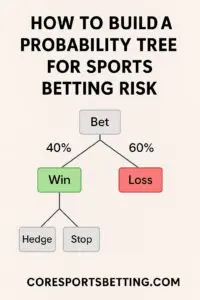
At this point, your probability tree has two branches:
• A 40% chance of winning $150
• A 60% chance of losing $100
Expanding the Tree: Adding Conditional Bets and Risk Layers
Once you understand a basic single-level tree, the real power comes from adding conditional decisions.
For example, suppose you plan to hedge your bet or reinvest winnings in a new bet depending on the first result. Each new decision adds another layer of branches.
Let’s say:
- If you win the first bet, you’ll reinvest $100 in a second game with 50% chance to win $120 or lose $100.
- If you lose the first bet, you’ll stop.
Now your branches multiply:
| Path | Probability | Result |
| Win → Win | 0.40 × 0.50 = 0.20 | +$270 total |
| Win → Lose | 0.40 × 0.50 = 0.20 | +$50 total |
| Lose → Stop | 0.60 | -$100 total |
You can now compute your overall expected value:
EV = (0.20 × 270) + (0.20 × 50) + (0.60 × -100)
EV = 54 + 10 − 60 = 4
So your total expected value is +$4 on a $100 stake – a +4% edge over the long run.
Why this matters:
By visualizing your bets as branches, you can see how your second decisions affect total risk and reward. Without a probability tree, most bettors underestimate their risk exposure.
How to Calculate Combined Probability and Return
Each final branch in your probability tree represents one complete outcome.
To find the probability of any specific outcome, multiply the probabilities along the path that leads to it.
For example:
P(win first and lose second) = P(win first) × P(lose second | win first)
Once you have the probability of each outcome, multiply that probability by the total dollar result of that outcome. Then add all these values together to get your total expected value (EV).
This approach helps you answer important questions such as:
- What’s the probability that I’ll lose more than $200?
- How likely am I to double my bankroll?
- Which paths carry the highest risk vs. the best reward?
Many bettors also color-code their outcome branches to visualize risk:
green for favorable outcomes, red for large losses, and yellow for moderate-risk scenarios.

Visualizing Risk and Variance
Once your tree is built, you can visualize risk distribution. Each branch tells you not just what could happen, but how likely it is. This visualization makes it easy to spot where you’re overexposed.
For example:
- If your tree shows several branches with small wins but one with a large loss, that’s asymmetric risk – you could have positive EV but still face large drawdowns.
- If your branches have balanced outcomes (moderate wins/losses), your risk is symmetrical, meaning your bankroll is safer even if your edge is small.
You can even use color or shading in a spreadsheet to create a simple “heat map” of risk. Many handicappers do this by labeling:
- Green branches: high-probability, low-risk wins
- Red branches: low-probability, high-loss scenarios
This helps identify whether your betting strategy fits your risk tolerance.
Example: Probability Tree for an MLB Parlay Decision
Let’s take a real-world style example. Suppose you plan to parlay two MLB games:
- Game 1: +130 odds (implied win probability 43%)
- Game 2: -110 odds (implied win probability 52%)
You can represent this in a probability tree like this:
- First branch:
- Win first game (43%)
- Lose first game (57%)
- Second branch (only if first wins):
- Win second game (52%)
- Lose second game (48%)
Now calculate joint probabilities:
- Win both = 0.43 × 0.52 = 0.224 (22.4%)
- Win first, lose second = 0.43 × 0.48 = 0.206 (20.6%)
- Lose first = 0.57 (57%)
Let’s assume:
- Winning both pays +3.4× your stake (parlay payout).
- Win one but lose other = -1× (lose parlay).
- Lose both = -1× (lose parlay).
EV = (0.224 × 2.4) + (0.206 × -1) + (0.57 × -1)
EV = 0.538 − 0.776 = -0.238
So your expected value is -0.238 units per unit wagered, which is about -23.8%.
Even though each individual bet might seem reasonable, the probability tree shows that the combined risk of the parlay makes it a negative-EV play. This is exactly the type of insight many handicappers miss when they don’t visualize the full probability paths.
Using Probability Trees for Bankroll Management
Another advantage of knowing how to build a probability tree for sports betting risk is better bankroll control.
By mapping every outcome, you can:
- Set appropriate bet sizes
- Estimate potential drawdowns
- Avoid doubling up on correlated bets
How to use your tree for bankroll management? Well, before any bet:
- List every possible outcome on your probability tree (win, loss, next decision).
- Calculate total exposure: Multiply each branch’s probability by its potential loss.
- Compare that to your bankroll size: If the worst-case branch would reduce your bankroll by more than 5–10%, you’re betting too large.
Common Pitfalls When Using Probability Trees
While probability trees are powerful, they aren’t magic. Here are common mistakes bettors make – and how to fix them.
- Overcomplicating the tree: Some bettors try to model every possible outcome (injuries, overtime, player performance). That leads to dozens of branches that become unusable.
Fix: Focus on 2–3 decision levels max. Only include outcomes that truly affect your bankroll.
- Using inaccurate probabilities: The quality of your tree depends entirely on your probability inputs. If you base your numbers on gut feelings instead of data, the output is meaningless.
Fix: Use implied probabilities, then adjust slightly based on model estimates or recent performance data.
- Ignoring correlations: If two branches depend on the same factor (like weather or injuries), your probabilities aren’t independent.
Fix: Combine those events or reduce the number of correlated branches.
- Forgetting the vig: Sportsbooks build in juice, so the implied probabilities from odds will always total above 100%.
Fix: Normalize implied probabilities by dividing each by the total sum.
Example:
If Team A is 1.91 and Team B is 1.91:
Implied probabilities = 1/1.91 = 0.523 each
Sum = 1.046
Normalized = 0.523 / 1.046 ≈ 0.50 each.
This correction ensures your probability tree is mathematically accurate.
The Big Picture: Turning Visualization into Profit
Learning how to build a probability tree for sports betting risk isn’t just about math – it’s about changing how you think.
Most bettors view each wager in isolation. But some bettors think in distributions. They ask: “What’s my expected return across all future possible outcomes?”
By visualizing those outcomes as a tree, you stop reacting emotionally to single losses. You’ll start making decisions based on structure, not impulse. Over time, this builds the discipline that separates casual bettors from long-term winners.
Conclusion
A probability tree is one of the simplest yet most powerful tools for serious bettors. It helps you visualize your entire betting journey – not just the next game.
By learning how to build a probability tree for sports betting risk, you can break down complex betting sequences into clear, measurable paths. You’ll understand your exposure, calculate expected value, and choose smarter bet sizes with confidence.
Before You Go…
Get Weekly Winning Angles Delivered to You
Enjoy this article? Join the Core Sports Betting newsletter where we break down actionable strategies, betting angles, and real-game insights.
Some of the concepts we touch on each week can evolve into full handicapping systems – the kind you can test, refine, and potentially build into long-term edges.
Simple. Practical. No fluff.
Proven Sports Betting Courses
Looking to go deeper?
Our step-by-step courses are built around structured systems – not guesses or opinions. Each course has been backtested over a minimum of 10 years, giving you a clear understanding of how the strategy has performed over time.
If you’re serious about improving your process, these courses show you exactly how to approach betting with discipline and structure.
Free Betting Calculators to Sharpen Your Edge
Want to make smarter, faster decisions?
Our free tools help you quickly calculate odds, payouts, and true value — without the guesswork.
Try these popular calculators:
- Moneyline Calculator
- Parlay Calculator
- No-Vig Odds Calculator (Find True Odds)
- Kelly Criterion Calculator
→ Visit the Betting Tools Hub to access all calculators
Like this article? Pin it on Pinterest!

More to Explore