Golf tournaments present bettors with a challenge that is different from many other sports. The playing…
How to Use Compubox Punch Stats for Live Boxing Bets

Boxing is a sport defined by rhythm, pace, and precision – and no single metric captures those elements better than punch volume. Whether you’re wagering before the opening bell or firing live bets round by round, understanding how to use CompuBox punch stats for live boxing bets can be the difference between a casual guess and a calculated edge.
Punch stats are not just numbers on a screen – they’re a window into fighter tendencies, stamina, and control of the ring. By learning how to interpret and apply them strategically, you can spot value long before the sportsbooks adjust. In this guide, we’ll break down where to find punch volume data, how to use it step by step, and how to turn those insights into profitable wagers.
Why Punch Volume Matters in Boxing Betting
Before we jump into specifics, let’s make one thing clear: punch stats are far more than trivia. They’re a measurable reflection of a fight’s tempo, control, and scoring potential.
Judges score based on clean and effective punching, defense, ring generalship, and aggression – and punch volume influences at least two of those directly. A fighter who throws and lands more punches is often seen as dictating the pace, controlling the fight, and building a scoring cushion, especially in close rounds.
In live betting, the implications grow even bigger. Punch stats can tell you who’s fading, who’s surging, and where the momentum might swing – sometimes before the odds reflect it. That’s why serious bettors are increasingly building strategies around how to use CompuBox punch stats for live boxing bets rather than relying on gut feelings or broadcast narratives.
Where to Find Punch Stats Online
To use punch stats effectively, you first need reliable data sources. These are the best options for both pre-fight research and real-time betting decisions:
1. CompuBox Official Website
CompuBox is the gold standard for punch statistics. It tracks jabs vs. power punches thrown and landed, accuracy percentages, and round-by-round totals. Visit compuboxdata.com for fighter history, bout breakdowns, and division averages.
How to use it:
- Look up fighters’ last 3–5 bouts to find their average punches thrown per round and accuracy rates.
- Record jab percentages vs. power punches to understand stylistic tendencies.
- Note how many punches they allow opponents to land – a key defensive metric.
2. @CompuBox on X (Twitter)
CompuBox’s live social feed is essential for in-play bettors. They post round-by-round punch counts during major cards, often before odds shift.
How to use it:
- Follow during live fights for immediate volume updates.
- Watch for sudden surges or drops in pace, which may indicate a momentum shift.
- Combine these updates with your pre-fight notes to confirm or challenge your original bets.
ESPN Boxing & The Ring Magazine
Both ESPN and The Ring regularly publish punch stat breakdowns and previews featuring CompuBox data. These resources are excellent for context – things like how a fighter’s pace compares to division averages or how much volume typical title fights feature.
How to use it:
- Look for style analysis and punch rate comparisons in fight previews.
- Save post-fight breakdowns to build a personal database for future matchups.
- Use division averages as benchmarks when projecting pace and outcomes.
Step-by-Step: Pre-Fight Handicapping with Punch Stats
Before the first bell rings, you can already build a strong foundation for your bets by analyzing historical punch data. Here’s how to do it:
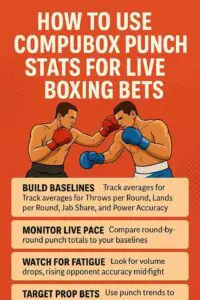
Build a Fighter Baseline Sheet
Start by pulling each fighter’s last 3–5 fights and tracking these metrics:
- Throws per Round (TPR): Average total punches thrown per round.
- Lands per Round (LPR): Average landed punches per round.
- Jab Share (%): Percentage of total punches that are jabs.
- Power Accuracy (%): Percentage of power punches landed.
- Opponent LPR Allowed: How many punches they allow opponents to land per round.
How to do it: Create a simple spreadsheet and fill in these metrics for both fighters. This becomes your comparison chart.
Calculate a “Volume Edge Index” (VEI)
To quickly measure who controls pace and scoring potential, create a simple index:
VEI = (TPR_A − TPR_B) + 0.5 × (PowerAcc_A − PowerAcc_B) + 0.25 × (JabShare_A − JabShare_B)
- A strongly positive VEI suggests Fighter A likely dictates pace and wins more rounds.
- A strongly negative VEI suggests Fighter B does.
How to do it: Use past fight averages. If Fighter A throws 65 punches per round and Fighter B throws 50, that’s a +15 pace advantage. Combine that with accuracy and jab share differences for a clearer edge.
Apply Style Filters
Raw volume is only part of the picture. How fighters use that volume matters:
- High jab share + good accuracy: Indicates a fighter who controls range and wins decisions.
- Low jab share + high power accuracy: Suggests a fighter who relies on big moments and KO potential.
How to do it: Use jab and power punch breakdowns to predict outcomes. A jab-heavy fighter is more likely to win decisions; a power-puncher is more likely to score a stoppage if pace holds.
Check Defensive Metrics
Volume matters on both sides. A fighter who limits opponents’ landed punches per round can neutralize a volume advantage.
How to do it: Compare each fighter’s “opponent LPR allowed.” A strong defensive fighter may win close rounds despite lower output.
Apply Findings to Betting Markets
Once you’ve analyzed the data, look at available markets:
- Moneyline: Favor the fighter with the higher VEI and better defense.
- Method of Victory: If jab share and accuracy point to control, target Decision. If power accuracy and opponent absorption are high, consider KO/TKO.
- Total Rounds: Use pace metrics to estimate whether the fight leans Over or Under.

Step-by-Step: Using CompuBox Punch Stats for Live Betting
Live betting is where punch stats shine brightest. Round-by-round volume data lets you react faster than the books – if you know what to look for.
Here’s a step-by-step process to guide your live betting approach:
Pre-Load Your Baselines
Before the fight starts, have your baseline spreadsheet open. Know what each fighter’s typical TPR, LPR, jab %, and power accuracy are.
How to do it: Keep these averages in front of you so you can immediately spot deviations.
Monitor Pace vs. Baseline
During the fight, compare live stats (from @CompuBox or broadcast graphics) against your baseline:
- Sustained +8 to +12 punches per round above baseline signals momentum.
- Sudden dips may indicate fatigue or injury.
Example: If a fighter normally throws 55 punches per round but is averaging 70 through three rounds, their volume edge is stronger than expected – and live odds might not yet reflect that.
Watch the Fatigue Curve
Most fighters show signs of slowing between rounds 5 and 8 in 10- or 12-round fights. A 15–20% drop in volume plus rising opponent power accuracy often signals a momentum flip.
How to do it: Look for live stats showing reduced output and rising opponent success rates. This might be the moment to jump on a live underdog or hedge your pre-fight bet.
Use Punch Trends to Target Prop Bets
Live stats don’t just point to the winner – they help you time method and total bets:
- Increasing jab dominance: Lean toward Over Rounds or Decision props.
- Spiking power accuracy, especially to the body: Lean toward late KO/TKO props.
How to do it: Combine live pace trends with observed damage and opponent body language to time prop entries.
Building a Simple Punch Stat Worksheet
To make this process repeatable, create a simple worksheet with the following columns:
- Fighter Name
- Throws per Round (TPR)
- Lands per Round (LPR)
- Jab Share %
- Power Accuracy %
- Opponent LPR Allowed
- Live Round-by-Round Totals
- Δ From Baseline (difference vs. averages)
How to do it: Fill this sheet pre-fight with historical averages, then update round-by-round with live stats. Highlight any deltas (differences) that exceed your thresholds (+10 punches per round, +5% accuracy, etc.) to trigger potential live bets.
Common Pitfalls and Misinterpretations
While punch stats are powerful, they’re not infallible. Keep these limitations in mind:
- Volume ≠ scoring alone: Judges consider quality, not just quantity. A fighter can out-throw but still lose rounds if their shots lack impact.
- Human error: CompuBox counts are logged manually by trained operators and may have slight inaccuracies.
- Context matters: A fighter throwing 80 punches per round against a low-volume opponent may not maintain that pace against an elite pressure fighter.
Tip: Treat punch stats as contextual signals, not standalone predictors. They’re most powerful when combined with stylistic analysis and live observations.
Conclusion: Turn Numbers Into Edges
Learning how to use CompuBox punch stats for live boxing bets is about more than memorizing numbers – it’s about transforming those numbers into actionable insights. By building pre-fight baselines, monitoring live deviations, and interpreting trends in jab share, pace, and power accuracy, you can make smarter bets before and during fights.
The next time you watch a card, keep your punch stat worksheet handy. Track how the fight unfolds round by round. You’ll soon notice moments – small changes in pace, accuracy, or volume – that sportsbooks may overlook.
Before You Go…
Get Weekly Winning Angles Delivered to You
Enjoy this article? Join the Core Sports Betting newsletter where we break down actionable strategies, betting angles, and real-game insights.
Some of the concepts we touch on each week can evolve into full handicapping systems – the kind you can test, refine, and potentially build into long-term edges.
Simple. Practical. No fluff.
Proven Sports Betting Courses
Looking to go deeper?
Our step-by-step courses are built around structured systems – not guesses or opinions. Each course has been backtested over a minimum of 10 years, giving you a clear understanding of how the strategy has performed over time.
If you’re serious about improving your process, these courses show you exactly how to approach betting with discipline and structure.
Free Betting Calculators to Sharpen Your Edge
Want to make smarter, faster decisions?
Our free tools help you quickly calculate odds, payouts, and true value — without the guesswork.
Try these popular calculators:
- Moneyline Calculator
- Parlay Calculator
- No-Vig Odds Calculator (Find True Odds)
- Kelly Criterion Calculator
→ Visit the Betting Tools Hub to access all calculators
Like this article? Pin it on Pinterest!

More to Explore