Golf tournaments present bettors with a challenge that is different from many other sports. The playing…
Psychology of Loss Aversion in Sports Betting – How Loss Aversion Affects Sports Betting Decisions

Most handicappers believe success in sports betting is all about numbers – analyzing stats, studying matchups, and hunting for value in the odds. But even the sharpest data analysis won’t save you if your decisions are controlled by powerful psychological biases. One of the most common – and most damaging – is loss aversion.
Understanding how loss aversion affects sports betting decisions can be the difference between long-term profit and repeated frustration. It’s not just some psychology term – it’s the invisible force that causes bettors to chase losses, hedge unnecessarily, cash out too early, and abandon strategies that actually work. And because it operates mostly on a subconscious level, most bettors never realize it’s the real reason they’re stuck in a cycle of poor decisions.
This article will try to break down exactly what loss aversion is, how it shows up in your betting, why it’s so important to recognize, and most importantly, how to manage it before it sabotages your bankroll again.
What Is Loss Aversion?
Loss aversion is a psychological principle first identified by Nobel Prize–winning researchers Daniel Kahneman and Amos Tversky. It refers to the human tendency to feel the pain of a loss much more intensely than the pleasure of a gain of the same size.
In other words, losing $100 feels worse than winning $100 feels good. The emotional weight of the loss outweighs the satisfaction of the gain, often by a factor of two or more.
This bias is deeply rooted in human evolution. Our ancestors who were more sensitive to losses – such as losing food, resources, or safety – were more likely to survive. But in modern contexts like investing or sports betting, that same instinct often works against us.
Here’s a simple example:
- A bettor wins $100 on Sunday’s NFL game and feels mildly happy.
- The next day, they lose $100 on a hockey bet and feel deeply upset – so upset that they immediately try to win it back.
The dollar amount is identical, but the emotional impact is not. That’s loss aversion in action.
And this imbalance is at the heart of why so many bettors struggle to stay disciplined. Once you understand how loss aversion affects sports betting decisions, you can start spotting the subtle ways it hijacks your thinking.
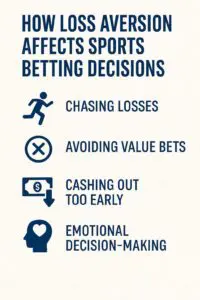
How Loss Aversion Affects Sports Betting Decisions
Loss aversion influences betting in more ways than most people realize. It doesn’t just cause impulsive decisions after a tough loss – it shapes your behavior before, during, and after you place a wager. Below are the most common ways it shows up and how it quietly drains your bankroll.
Chasing Losses – The Most Obvious Trap
The most well-known impact of loss aversion is chasing losses – placing bigger or riskier bets after a losing streak to “get even.”
This behavior is rarely about logic. It’s driven by the deep emotional discomfort of losing. The bettor isn’t trying to maximize expected value; they’re trying to erase the pain of the loss.
Example:
You lose three straight NBA bets totaling $300. Instead of sticking to your usual $100 unit size, you bet $300 on the next game to “win it all back.” If that bet loses too, the cycle escalates – and before you know it, you’ve doubled or tripled your losses.
How to counter it:
- Pre-set unit sizes and never deviate, no matter the results.
- Pause after losses – even for a short time – before placing another bet.
- Keep a written record of your bets and review them weekly to see if you’re increasing stakes after losses.
Avoiding Value Bets Because of Fear
Loss aversion doesn’t just make bettors reckless – it can also make them overly cautious. Many bettors avoid placing wagers that are statistically valuable because they’re too focused on the possibility of losing.
Example:
You calculate that a +220 underdog has a 40% chance to win — making it a +EV (positive expected value) bet. But because a loss would “hurt,” you skip it and instead bet on a heavy favorite with negative expected value just to feel safer.
The irony? Over time, this mindset causes far more losses than it prevents. By avoiding short-term discomfort, you sabotage your long-term edge.
How to counter it:
- Focus on expected value, not win percentage. A bet can lose 60% of the time and still be profitable if the odds are high enough.
- Review historical results in 100+ bet samples to understand variance – and how short-term losses don’t define profitability.
Cashing Out Too Early
Another classic symptom of loss aversion is cashing out winning bets too soon. Bettors lock in smaller profits early because they fear watching a winning ticket turn into a loser.
Example:
You place a $100 parlay that could pay $500. After the first three legs hit, the sportsbook offers a $240 cash-out. Even though the last leg is a heavy favorite, fear of losing it all makes you take the early payout.
While this might feel like a win, it’s often a -EV decision long-term. Sportsbooks design cash-out offers to exploit your fear – and most bettors don’t realize how much value they leave on the table.
How to counter it:
- Treat cash-out offers as a mathematical question, not an emotional one. Compare the implied probability of your remaining leg to the payout offer.
- If the offer undervalues your ticket, let it ride according to your original plan.
Over-Hedging Bets
Hedging can be a smart tool in certain scenarios, but loss-averse bettors often hedge far too much – cutting potential profits just to “lock something in.”
Example:
You bet $500 on a futures ticket that will pay $3,000 if the team wins the championship. When they reach the finals, you hedge $1,000 on the other team. Even if your original bet wins, your profit is slashed by more than half.
Most of the time, this isn’t about strategy – it’s about fear. Bettors don’t want to face the emotional sting of watching a winning position vanish, even if the math says to stay the course.
How to counter it:
- Hedge only when the expected value of hedging is positive, not just to ease anxiety.
- Create a written hedge plan before the tournament starts and stick to it regardless of emotion.
Emotional Tilt and Impulsive Betting
Loss aversion doesn’t just affect individual bets – it affects your mindset. After losses, bettors often feel an overwhelming urge to “get it back” – leading to impulsive wagers they would never place under normal circumstances.
This is known as tilt – a term borrowed from poker. Losses cloud judgment, erode discipline, and create a cycle of bad decisions.
How to counter it:
- Build in cool-off periods after significant losses. Even 24 hours off can reset your decision-making.
Limit the number of bets you place per day or per week. Fewer decisions mean less room for emotional errors.
Why Understanding Loss Aversion Is So Important
Recognizing how loss aversion affects sports betting decisions isn’t just about psychology – it’s about profitability. Bettors who fail to account for it consistently make mistakes that crush their edge.
Here’s why mastering this concept is so important:
- It protects your bankroll. Chasing losses and over-betting can wipe you out quickly. Understanding loss aversion helps you avoid those traps.
- It improves long-term returns. Bettors who ignore emotional reactions and stick to +EV bets win more over time.
- It exposes sportsbook tactics. Promotions, cash-out offers, and bet boosts are often designed to exploit loss-averse behavior. Recognizing this gives you an edge.
- It builds discipline. Controlling your reactions to losses makes you more consistent – and consistency is everything in betting.
How to Recognize and Overcome Loss Aversion
Loss aversion is powerful, but it’s not unbeatable. Once you’re aware of how it influences you, you can build systems and habits to reduce its impact. The key is to address it at every stage of the betting process – before, during, and after you place a wager.
Before Betting: Build a System That Keeps Emotions Out
Before you even place a bet, you can reduce loss aversion by creating structure and discipline.
- Set clear bankroll rules.
Divide your total bankroll into units (usually 1–2% of your bankroll each). For example, if your bankroll is $5,000, one unit is $50–$100. This ensures a single loss never hurts enough to trigger emotional decisions. - Use a staking strategy.
Fixed-unit or Kelly Criterion staking helps you size bets based on math, not emotion. Kelly, for instance, sizes bets based on your estimated edge, automatically limiting overreaction after losses. - Predefine stop-loss limits.
Decide in advance how much you’re willing to lose in a day or week. Once you hit that number, stop betting. This prevents emotional spirals and tilt. - Create a written betting plan.
Outline how you’ll select bets, how you’ll size them, and how you’ll react to losses. Writing it down makes it harder to deviate when emotions run high.
During Betting: Control Emotional Decisions in Real Time
While bets are live, loss aversion tries to hijack your thinking. Awareness and proactive habits can keep it in check.
- Track emotional triggers.
Keep a simple log of how you feel before and after each bet. Are you nervous? Anxious? Overconfident? Over time, you’ll spot patterns – and awareness alone reduces their power. - Pause after losses.
Don’t fire off another bet immediately after losing. Take a walk, step away from the screen, or review your notes. Even a short pause reduces impulsivity. - Stick to your pregame analysis.
Don’t second-guess yourself mid-game or mid-season based on emotional swings. If your original reasoning was sound, trust the process.

After Betting: Focus on Process, Not Outcomes
Once a bet settles, how you review it determines whether you learn or repeat mistakes.
- Review decisions, not results.
Instead of asking “Did I win?”, ask “Was it a good bet?” If the bet was +EV and aligned with your strategy, it was a success – even if it lost. - Embrace variance.
Losses are part of the game. The best bettors in the world lose 45–50% of the time. By focusing on the long term, individual losses lose their emotional sting. - Simulate long-term results.
Look at your betting strategy over 100+ bets. Seeing the bigger picture helps you understand variance and prevents overreactions to short-term swings.
Real-World Example – How Loss Aversion Destroyed a Bankroll
Let’s look at a hypothetical example that illustrates just how destructive unchecked loss aversion can be.
John starts the NFL season with a $2,000 bankroll, betting $100 per game. He loses his first three bets in Week 1 – down $300. Frustrated, he bets $300 on a Sunday Night Football game to “win it all back.” That bet loses too, dropping him to $600 in the hole.
Now angry, John bets $600 on Monday Night Football, reasoning that if he wins, he’ll be back to even. He loses again – bankroll now $1,100. By Week 2, he’s chasing $900 in losses, his unit sizing is all over the place, and his decision-making is purely emotional. Within three weeks, his bankroll is gone.
The tragedy? John’s original strategy was sound. But he never stood a chance because loss aversion – not math – was making his decisions.
Building a Mindset for Long-Term Betting Success
Overcoming loss aversion isn’t about eliminating emotion – that’s next to impossible. It’s about managing it so it doesn’t control your decisions. That means shifting your mindset from short-term outcomes to long-term process.
- Think like an investor. Portfolio managers don’t panic after one losing trade. They evaluate based on hundreds of trades over time. You should do the same.
- Redefine “winning.” A good bet is one with positive expected value, not necessarily one that wins today.
- Accept losses as data. Each loss teaches you something about variance, your process, or your discipline. Learn from them instead of reacting to them.
The bettors who thrive long-term aren’t necessarily better at picking winners. They’re better at managing psychology – and loss aversion is the first battle they learn to win.
Conclusion – Master the Mind, Master the Game
Loss aversion is one of the most powerful psychological forces in sports betting. It’s hardwired into us, it’s invisible while it’s happening, and it’s responsible for many of the worst decisions bettors make. But once you understand how loss aversion affects sports betting decisions, you can build systems, habits, and a mindset that neutralizes its power.
Discipline, structure, and long-term thinking are your best weapons. Focus on expected value, not short-term results. Trust your process, not your emotions. And above all, remember: every bettor feels the sting of a loss – but the ones who succeed are those who learn to control their reaction to it.
Before You Go…
Get Weekly Winning Angles Delivered to You
Enjoy this article? Join the Core Sports Betting newsletter where we break down actionable strategies, betting angles, and real-game insights.
Some of the concepts we touch on each week can evolve into full handicapping systems – the kind you can test, refine, and potentially build into long-term edges.
Simple. Practical. No fluff.
Proven Sports Betting Courses
Looking to go deeper?
Our step-by-step courses are built around structured systems – not guesses or opinions. Each course has been backtested over a minimum of 10 years, giving you a clear understanding of how the strategy has performed over time.
If you’re serious about improving your process, these courses show you exactly how to approach betting with discipline and structure.
Free Betting Calculators to Sharpen Your Edge
Want to make smarter, faster decisions?
Our free tools help you quickly calculate odds, payouts, and true value — without the guesswork.
Try these popular calculators:
- Moneyline Calculator
- Parlay Calculator
- No-Vig Odds Calculator (Find True Odds)
- Kelly Criterion Calculator
→ Visit the Betting Tools Hub to access all calculators
Like this article? Pin it on Pinterest!

More to Explore