Golf tournaments present bettors with a challenge that is different from many other sports. The playing…
UFC Round Betting Strategies Grappler vs Striker Matchups

Round betting is one of the most exciting – and potentially profitable – ways to wager on UFC fights. Instead of simply picking who wins or how, round betting lets you predict when the fight will end or when a fighter will secure the victory. But while this opens up new opportunities for value, it also adds complexity. Few matchups illustrate this better than the classic grappler vs striker clash – a stylistic battle that often unfolds in distinct phases from round to round.
That’s why understanding UFC round betting strategies grappler vs striker matchups is such a powerful edge for bettors. These fights tend to follow certain patterns: strikers usually look to impose their will early when both fighters are fresh, while grapplers often aim to wear down their opponent and take over as fatigue sets in. Knowing how and when those stylistic advantages typically shift can help you anticipate which rounds offer the best betting opportunities – and which props may be overpriced or undervalued.
In this guide, we’ll break down everything you need to know about round betting in grappler vs striker fights, including:
- How these fights usually evolve from Round 1 onward
- Which rounds historically favor strikers vs grapplers
- A round-by-round breakdown of betting tendencies
- Key metrics and factors to analyze before placing a round prop bet
- Real-world strategies and examples that help you turn stylistic matchups into profit
By the end, you’ll have a complete framework for approaching UFC round betting strategies grappler vs striker matchups with more insight and confidence – and a sharper sense of where the betting value really lies.
Understanding Round Betting in UFC: A Quick Primer
Before diving into strategy, it’s worth clarifying what round betting actually is. Unlike traditional moneyline bets, where you simply pick who wins the fight, round betting focuses on when the fight ends. Common types of round bets include:
- Exact round finish bets – e.g., “Fighter A wins in Round 2.”
- Grouped round bets – e.g., “Fighter A wins in Rounds 1–2.”
- Fight ends in Round X – regardless of who wins.
- Over/Under round totals – predicting if the fight will last beyond a set round mark (e.g., over 2.5 rounds).
Because these wagers are more specific, the odds are often significantly higher than moneyline or method-of-victory bets. That higher payout potential is attractive – but it comes with more variance and more room for error. That’s why context, matchup analysis, and style dynamics are critical.
And no dynamic influences fight flow more consistently than grappler vs striker matchups. These fights reveal how contrasting game plans can dictate pace, control, and the likelihood of a finish at various stages. Understanding that evolution is the foundation of effective UFC round betting strategies grappler vs striker matchups.
Grappler vs Striker Dynamics: How Styles Dictate Fight Flow
One of the oldest narratives in MMA is the clash of styles – the relentless takedown-heavy grappler versus the explosive knockout striker. It’s not just a cliché. This contrast often leads to highly predictable round-by-round dynamics that bettors can exploit – if they understand how these styles interact.
At its core, the grappler’s goal is to neutralize distance and eliminate striking opportunities. They aim to close the gap, initiate clinches, and secure takedowns where they can control position, inflict damage with ground-and-pound, or hunt for submissions. Their success depends heavily on timing, positioning, and wearing down the opponent’s defenses over time.
Strikers, on the other hand, want to maximize space and time, staying on their feet to land damaging shots. They look to dictate range, punish failed takedown attempts, and score points or finishes before the grappler can slow them down. Early rounds – when both fighters are fresh – are typically where strikers have the most explosive potential.
These contrasting objectives create natural shifts in fight momentum, often aligning with specific rounds:
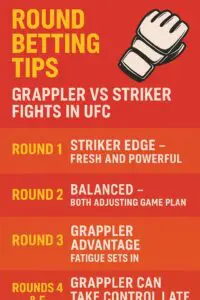
- Round 1: Striker edge due to freshness, speed, and takedown defense.
- Rounds 2–3: Grappler’s control often increases as the fight wears on.
- Rounds 4–5: Conditioning, cumulative damage, and control time become decisive – usually favoring grapplers, though one clean strike can still change everything.
Understanding this rhythm is key to building profitable UFC round betting strategies grappler vs striker matchups. Let’s explore how each round typically plays out and what that means for your wagers.
Round-by-Round Breakdown: Where Each Style Gains the Edge
Before jumping into strategy, it’s important to approach this round-by-round analysis as a set of tendencies, not absolutes. MMA is unpredictable, and fighters evolve. But by studying hundreds of fights, clear trends emerge that can guide where value might exist in round betting.
Round 1: The Striker’s Best Chance
Why it matters:
The opening round is often the striker’s ideal window. Fighters are fresh, reflexes are sharp, and takedown defense is at its peak. Grapplers may need a minute or two to gauge timing and distance, and aggressive strikers can capitalize on that hesitation.
Betting implications:
- Striker wins in Round 1 props are often priced shorter (+250 to +400) but reflect genuine opportunity.
- Look for matchups where the striker has a history of early finishes – particularly if their opponent has shown vulnerability before establishing control.
- Conversely, if the grappler tends to shoot early and often, Round 1 might still offer value for a quick submission – but these are rarer.
How to analyze:
- Review past fights to see how quickly the striker starts. A fast starter with high early striking volume is more likely to score a finish before grappling pressure builds.
- Consider the grappler’s early takedown success rate. Low first-round accuracy suggests the striker has a window.
Example: In Conor McGregor vs Chad Mendes (UFC 189), McGregor – a pure striker – nearly overwhelmed Mendes early despite Mendes’ wrestling pedigree. Although Mendes secured takedowns, McGregor’s striking pressure forced a Round 2 finish. Bettors who understood the early-round striker advantage had strong value in first- and second-round McGregor props.
Round 2: The Adjustment Phase
Why it matters:
By Round 2, both fighters have tested their opponent’s game plan. Grapplers adjust their entries, and strikers recalibrate their timing. This is the round where many grappler vs striker fights begin to swing – either the striker doubles down on damage, or the grappler starts finding consistent takedown success.
Betting implications:
- Round 2 finish props can carry significant value (+400 to +700) because books often underprice stylistic adjustments.
- Grapplers often secure their first sustained control here, especially if the striker expended energy in Round 1.
- Strikers with knockout power remain dangerous if they stuff early takedowns and force the grappler to strike.
How to analyze:
- Look for grapplers with a high takedown chain rate – those who shoot repeatedly even after initial failures. Persistence often pays off by Round 2.
- Watch for strikers who fade under pressure. If a striker’s volume drops dramatically in second rounds historically, grapplers gain a bigger edge.
Example: Khabib Nurmagomedov vs Michael Johnson (UFC 205) illustrates the Round 2 shift perfectly. Johnson found early striking success in Round 1, but once Khabib timed his entries, the grappling pressure became overwhelming – leading to a Round 3 submission. Bettors aware of Khabib’s round-by-round pattern had strong value in later-round props.
Round 3: The Battleground of Conditioning
Why it matters:
Round 3 in three-round fights – and the midpoint in five-rounders – often becomes a battle of cardio and resilience. By now, cumulative damage and fatigue shape the fight more than raw skill. Grapplers who imposed control earlier can dominate from top position. Strikers who avoided the mat may find openings as grapplers slow down.
Betting implications:
- Round 3 props tend to be among the longest odds (+600 to +1000), but they’re often where experienced bettors find hidden value.
- A striker with strong defensive grappling might exploit a tired opponent late.
- A grappler with relentless pressure might finally secure a finish after softening up the striker over earlier rounds.
How to analyze:
- Study significant strikes absorbed per minute and control time allowed. Fighters who break under pressure often do so by Round 3.
- Cardio history is key. A grappler known for pace and volume is more dangerous in late rounds than one who fades.
Example: In Colby Covington vs Robbie Lawler (UFC on ESPN 5), Covington’s relentless grappling pace wore Lawler down across rounds. While Covington didn’t finish, bettors who wagered on a Round 3 finish understood how attrition can swing fights.
Rounds 4 & 5: Championship Shifts
Why it matters:
Championship rounds (4 and 5) are rare territory for round props – but they offer some of the juiciest payouts. Few fights reach this point, and those that do often see grapplers in control. The ability to dictate pace and grind down opponents typically pays off late, though strikers with fight-ending power remain live.
Betting implications:
- Round 4 or 5 finish props can exceed +1000, offering significant risk-reward opportunities.
- If the grappler is historically dominant in deep waters, these rounds become ideal for late submission or TKO props.
- If the striker carries power late (think Derrick Lewis or Francis Ngannou), Round 4 or 5 knockout props can also hold sneaky value.
How to analyze:
- Check each fighter’s finishing distribution by round. Grapplers with high late-fight finish rates are rare but valuable targets.
- Review historical data on pace drops. Fighters who slow significantly in Round 4 are vulnerable.
Example: Kamaru Usman vs Colby Covington (UFC 245) reached the fifth round with Usman’s pressure steadily breaking Covington down. Usman secured a TKO in Round 5 – illustrating how grappling pace and attrition often culminate in late finishes.

Building a Betting Strategy for Grappler vs Striker Round Props
Knowing how styles interact by round is just the starting point. Successful bettors go deeper – analyzing data, spotting market inefficiencies, and structuring wagers intelligently. Here’s a blueprint for approaching UFC round betting strategies grappler vs striker matchups like a pro.
- Study Fighter Metrics That Predict Round Trends
Before placing a round prop, dig into the numbers that signal how a fight might unfold:
- Takedown accuracy & attempts per 15 minutes: Reveals how effective and persistent the grappler is.
- Takedown defense %: Key for strikers; above 70% often indicates early-round survival potential.
- Significant strike rate: High early volume means greater Round 1 danger from a striker.
- Control time per round: Grapplers with 3+ minutes of control per round are strong candidates for late finishes.
- Cardio indicators: Look for consistent output across rounds, not just Round 1 bursts.
How to use this:
Match these stats against each other to see where the fight might tip. A striker with 85% takedown defense and knockout power is a strong early threat. A grappler with 5+ takedown attempts per fight and elite cardio might dominate late.
- Target “Value Rounds” Instead of Favorite Rounds
Most bettors focus on Round 1 props because they feel “safer.” That’s why sportsbooks price them lower — and why deeper rounds often hold more value. If analysis suggests the grappler’s control grows as the fight progresses, Round 3 or 4 finish props might be mispriced.
How to do it:
- Compare implied probabilities of round props against your own estimates.
- If a Round 3 finish is priced at +800 (11.1% implied) but you estimate a 15% chance based on style and history, that’s a +EV (positive expected value) bet.
- Combine Round Props With Method Bets
One way to reduce variance is to correlate round bets with method props. For example, if you believe a grappler will secure a late submission, “Submission in Round 4” often pays more than just “Round 4 finish.” Likewise, pairing “Round 1 knockout” with a striker known for fast starts can amplify value.
How to do it:
- Look for fighters with clear finishing patterns (e.g., 80% of KOs in Round 1–2).
- Cross-reference finish method trends with round trends to narrow down prop selections.
- Use Live Betting to Adjust After Round 1
Grappler vs striker fights often reveal their story early. If the grappler is repeatedly stuffed in Round 1, later-round props on the striker gain value. If the striker is already fading, live odds on Round 3 or 4 submissions might be underpriced.
How to do it:
- Watch for key indicators: takedown success rate, ground control time, and striking volume.
- Adjust your bets in real time based on how the first round played out compared to pre-fight expectations.
- Manage Risk With Unit Sizing
Round betting is high variance — even perfect reads can miss by 30 seconds. Avoid overexposure:
- Keep round prop bets to 0.25–0.5 units each.
- Avoid stacking multiple round props on the same fight.
- Consider using grouped rounds (e.g., “Rounds 3–4”) for safer exposure with slightly lower payouts.
Common Pitfalls to Avoid
Even seasoned bettors make mistakes when approaching grappler vs striker round props. Here are a few traps to sidestep:
- Overvaluing stereotypes: Not all strikers gas late, and not all grapplers dominate Round 3. Check individual tendencies.
- Ignoring opponent quality: A strong striker with elite takedown defense can flip the expected dynamic.
- Chasing long shots blindly: Just because Round 5 pays +1600 doesn’t mean it’s good value. Only bet if the data supports it.
- Forgetting variance: Even perfect reads can miss due to referee stoppages, cut-induced doctor interventions, or flash KOs.
Conclusion: Mastering Round Betting Through Stylistic Insight
The best bettors know that profitable UFC round betting isn’t about luck – it’s about understanding how styles clash and how those clashes evolve over time. Grappler vs striker matchups are among the most predictable in terms of fight flow, and that makes them fertile ground for bettors who study round-by-round dynamics.
By breaking fights down into phases, analyzing key metrics, and applying the strategies in this guide, you can build more confident and consistent wagers. Whether it’s capitalizing on a striker’s Round 1 explosiveness or backing a grappler’s attrition in Rounds 3–5, understanding UFC round betting strategies grappler vs striker matchups gives you a powerful edge in one of MMA’s most exciting betting markets.
Before You Go…
Get Weekly Winning Angles Delivered to You
Enjoy this article? Join the Core Sports Betting newsletter where we break down actionable strategies, betting angles, and real-game insights.
Some of the concepts we touch on each week can evolve into full handicapping systems – the kind you can test, refine, and potentially build into long-term edges.
Simple. Practical. No fluff.
Proven Sports Betting Courses
Looking to go deeper?
Our step-by-step courses are built around structured systems – not guesses or opinions. Each course has been backtested over a minimum of 10 years, giving you a clear understanding of how the strategy has performed over time.
If you’re serious about improving your process, these courses show you exactly how to approach betting with discipline and structure.
Free Betting Calculators to Sharpen Your Edge
Want to make smarter, faster decisions?
Our free tools help you quickly calculate odds, payouts, and true value — without the guesswork.
Try these popular calculators:
- Moneyline Calculator
- Parlay Calculator
- No-Vig Odds Calculator (Find True Odds)
- Kelly Criterion Calculator
→ Visit the Betting Tools Hub to access all calculators
Like this article? Pin it on Pinterest!

More to Explore