Golf tournaments present bettors with a challenge that is different from many other sports. The playing…
How to Handicap Usage Rate Props in NBA

When it comes to NBA player prop betting, most bettors focus on surface stats – points per game, recent box scores, or maybe a hot streak they saw on social media. But there’s a deeper layer hiding underneath those numbers, one that can give you a real edge if you know how to use it: usage rate.
This guide will walk you through how to handicap usage rate props in NBA, even if you’ve never looked at this stat before. We’ll break down what usage rate is, why it matters, how sportsbooks price it into their prop lines, and – most importantly – how to turn it into a tool for spotting mispriced opportunities.
What Usage Rate Actually Means (And Why It Matters)
Before we can learn how to handicap usage rate props in NBA, we need to understand what usage rate really is. At its core, usage rate measures how often a player ends a team’s possession with a shot attempt, a trip to the free-throw line, or a turnover while they’re on the court.
To say it simply – usage rate shows how involved a player is in their team’s offense.
For example, if a player has a usage rate of 30%, that means that 30% of all possessions while they’re on the floor end with that player shooting, getting fouled, or turning the ball over. That’s a major role – and it usually means that player will have lots of opportunities to rack up points, assists, and other counting stats.
This is why usage rate matters so much for prop betting. Player props – like points, assists, or points + assists + rebounds (PAR) – are opportunity-driven. If a player doesn’t touch the ball much, it’s hard for them to fill a stat sheet. But when a player’s usage rate spikes, it often signals more opportunities – and potentially more value – on the over side of certain props.
Why Sportsbooks Care About Usage Rate Too
It’s important to note that sportsbooks aren’t sleeping on usage rate. In fact, they’re well aware of how powerful it is, and they bake it into their player prop models. That means if you’re trying to figure out how to handicap usage rate props in NBA, you’re not the only one using this metric – the books are too.
However, they’re not perfect. Sportsbooks use automated models, historical data, and machine learning to set their lines. Those models are excellent at pricing props under normal conditions, but they’re not always fast (or accurate) at adjusting to sudden changes – like injuries, role changes, or coaching adjustments. That’s where sharp bettors find their edge.
Let’s say a team’s top scorer is out for the night. The next-highest usage player might see a significant bump in opportunities. If the sportsbook’s model hasn’t fully adjusted that player’s prop line to reflect the higher usage rate, there’s a potential edge on the over.
This is the art and science of how to handicap usage rate props in NBA: you’re not just looking at raw usage numbers, you’re trying to find situations where the real usage rate is likely to be different from what the sportsbooks expect.
Step-by-Step Guide: How to Use Usage Rate in Prop Betting
Now that we know what usage rate is and why it matters, let’s dig into the practical side – how you can actually apply it to real prop bets. Below is a complete, step-by-step breakdown you can follow to start spotting opportunities.
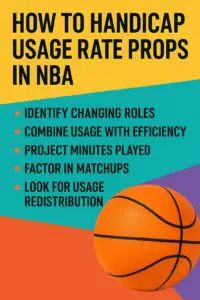
Step 1: Identify Players with Changing Roles
The first step in how to handicap usage rate props in NBA is to identify players whose roles might be changing. Static usage rates are useful, but they’re often already priced into prop lines. The real opportunities come when something shifts – and the sportsbook hasn’t fully accounted for it.
Here’s how to do it:
- Track injury reports: If a high-usage player is out, someone else on the team will need to take on more offensive responsibility. Identify the likely beneficiaries.
- Look for lineup changes: A player moving into the starting lineup often sees a usage increase, especially if they’re replacing a star.
- Watch coaching adjustments: Some coaches alter offensive schemes mid-season, which can change how much certain players are involved.
Example:
Imagine a team’s primary scorer is averaging 34% usage but is out with an injury. Their second option, who usually sits at 22%, could jump to 28–30% in their absence. If their points prop is still set based on that old 22% usage, there’s likely value on the over.
Step 2: Combine Usage Rate with Efficiency Metrics
Usage rate tells you how many opportunities a player gets – but it doesn’t tell you how well they use them. A player with 32% usage and poor shooting efficiency may still struggle to hit a high points prop. On the other hand, a player with 25% usage but elite true shooting might exceed expectations consistently.
Here’s how to use efficiency metrics alongside usage:
- True Shooting Percentage (TS%): Measures scoring efficiency by accounting for free throws and three-pointers.
- Assist Percentage (AST%): For assist props, shows how often a player assists while on the floor.
- Turnover Percentage (TOV%): Can signal whether a player’s usage is being “wasted” on turnovers.
How to use this:
If a player’s usage is climbing and they’re efficient, the odds of them surpassing their points or assists prop improve. If usage is high but efficiency is tanking, be cautious – the line may already reflect that.
Step 3: Understand Minutes and Playing Time Context
A high usage rate is meaningless if a player isn’t on the floor. Minutes are the engine that turns usage into actual stats. So, part of how to handicap usage rate props in NBA is projecting playing time accurately.
Here’s what to consider:
- Rotation patterns: Some players only play heavy minutes in certain matchups or when the team is short-handed.
- Blowout risk: A lopsided game could limit minutes for starters.
- Injury management: Veterans might get fewer minutes on back-to-backs.
Example:
A player with a 28% usage rate playing 24 minutes will have fewer opportunities than a player with a 25% usage rate playing 36 minutes. Always adjust your expectations based on likely floor time.
Step 4: Factor in Matchups and Opponent Style
Even with usage and minutes on your side, the matchup matters. A team that plays slow, deliberate basketball will naturally reduce the number of possessions – and thus opportunities. A fast-paced team or one that struggles defensively could boost prop outcomes.
Here’s how to evaluate matchups:
- Pace: Teams that play faster give more possessions and more chances for stats to accumulate.
- Defensive Rating: A weak defense could allow more scoring opportunities.
- Defensive Schemes: Some defenses focus on taking away certain players or actions, which can change usage distribution.
Example:
If a secondary scorer’s usage rises due to an injury and they’re facing a bottom-five defense in pace-adjusted points allowed, that’s a green flag for the over.
Step 5: Look for Usage Redistribution Scenarios
One of the most powerful ways to find edges is to anticipate how usage will redistribute when circumstances change. This is where many sportsbooks lag – and where bettors who understand how to handicap usage rate props in NBA can profit.
Here’s how to do it:
- Scenario planning: Ask “What happens if Player A is out?” or “What if this lineup gets extended minutes?”
- Historical patterns: Look back at past games when a key player was out — who picked up the usage slack?
- Overlap effects: Usage doesn’t just shift to one player. Sometimes it spreads among two or three secondary options.
Example:
If a team’s star guard (35% usage) is ruled out, the next-highest usage might go from 24% to 30%, and a bench scorer might jump from 19% to 25%. That ripple effect can create value on multiple props.

Where Bettors Still Have an Edge (and Where They Don’t)
Now that you know how to handicap usage rate props in NBA, it’s worth understanding where you can realistically beat the sportsbooks – and where the edge is thin.
Where Bettors Can Still Win:
- Late-breaking injury news: Books may not adjust quickly enough, especially on secondary players.
- Gradual role changes: A rising star’s usage creeping up over several games might be underpriced.
- Market overreactions: Sometimes usage dips briefly and prop lines overcorrect downward, creating value on overs.
Where Books Are Harder to Beat:
- Well-known stars: Books are extremely sharp on stars like Luka Doncic or Giannis, whose usage is heavily analyzed.
- Stable situations: If a team’s rotation and roles haven’t changed, usage-based props are often efficiently priced.
- High-liquidity markets: The more heavily bet the market, the harder it is to find a mispriced line.
Common Mistakes Bettors Make with Usage Rate
Understanding how to handicap usage rate props in NBA also means knowing what not to do. Here are a few pitfalls that trip up many bettors:
- Overvaluing usage: High usage doesn’t guarantee success. A volume scorer with low efficiency might still go under.
- Ignoring context: Usage without considering minutes, pace, and matchups can lead you astray.
- Chasing small sample sizes: A two-game spike in usage might be noise, not a trend.
- Betting too late: By the time the market fully adjusts, the edge may disappear.
Final Thoughts: Turn Usage Into Your Prop Betting Advantage
If you’re serious about improving your player prop results, mastering how to handicap usage rate props in NBA is one of the most powerful tools you can add to your arsenal. It’s not a magic bullet – sportsbooks are sophisticated, and usage rate is already part of their pricing models. But by digging deeper into context – role changes, injuries, efficiency, pace, and matchups – you can find situations where the books are just a step behind.
Start small, track your results, and refine your approach as you go. Over time, you’ll begin spotting mispriced props more quickly – and turning usage rate from just another stat into a real betting edge.
Before You Go…
Get Weekly Winning Angles Delivered to You
Enjoy this article? Join the Core Sports Betting newsletter where we break down actionable strategies, betting angles, and real-game insights.
Some of the concepts we touch on each week can evolve into full handicapping systems – the kind you can test, refine, and potentially build into long-term edges.
Simple. Practical. No fluff.
Proven Sports Betting Courses
Looking to go deeper?
Our step-by-step courses are built around structured systems – not guesses or opinions. Each course has been backtested over a minimum of 10 years, giving you a clear understanding of how the strategy has performed over time.
If you’re serious about improving your process, these courses show you exactly how to approach betting with discipline and structure.
Free Betting Calculators to Sharpen Your Edge
Want to make smarter, faster decisions?
Our free tools help you quickly calculate odds, payouts, and true value — without the guesswork.
Try these popular calculators:
- Moneyline Calculator
- Parlay Calculator
- No-Vig Odds Calculator (Find True Odds)
- Kelly Criterion Calculator
→ Visit the Betting Tools Hub to access all calculators
Like this article? Pin it on Pinterest!

More to Explore