Golf tournaments present bettors with a challenge that is different from many other sports. The playing…
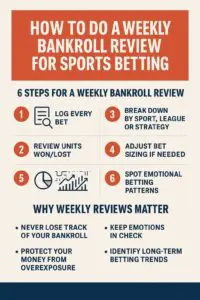
How to Do a Weekly Bankroll Review for Sports Betting

Sports betting is exciting, fast-paced, and full of opportunity, but without proper bankroll management, even skilled bettors can find themselves in trouble. One of the most overlooked habits among both casual and seasoned bettors is reviewing their bankroll on a regular basis. While some prefer daily or monthly check-ins, there’s a strong case for doing it weekly. It strikes the perfect balance between too frequent (which can create unnecessary stress) and too infrequent (which can allow bad habits to grow unchecked).
In this guide, we’ll walk through how to do a weekly bankroll review for sports betting in a step-by-step way that keeps you disciplined and informed. You’ll learn what to look for, how to analyze your results, why weekly reviews are crucial, and the simple methods to track performance across different sports and betting strategies. Whether you’re brand new or already an experienced bettor, making weekly reviews part of your routine will help you treat betting more like a business – and less like a guessing game.
What Is a Weekly Bankroll Review?
A weekly bankroll review is a structured process of analyzing your sports betting results from the past seven days. Instead of relying on memory or gut feeling, you look at hard numbers: wins, losses, profit/loss, return on investment (ROI), and betting patterns.
Think of it like a “health check” for your betting strategy. Just as you’d visit a doctor for regular checkups to prevent major problems, a weekly review helps you spot leaks in your betting approach before they become dangerous.
- Daily reviews can be too emotional since short-term swings don’t reveal much about strategy.
- Monthly reviews can sometimes be too late – by the time you notice a problem, you might already be down significantly.
Weekly reviews provide enough data to identify trends, but they’re also frequent enough to allow adjustments before things spiral out of control.
Why It’s Important to Review Weekly
Before we dig into the step-by-step process, it’s worth understanding why weekly reviews are so essential for sports bettors. Many people believe tracking bankroll is optional – but this thinking is dangerous. Here’s why:
- Prevents losing track of your money – Without tracking, you may be winning some bets but losing more without realizing it.
- Keeps emotions in check – Numbers don’t lie. A weekly review keeps you honest even if you feel like you “had a good week.”
- Helps preserve your bankroll – Betting is a marathon. A weekly check ensures you’re not betting too large or chasing losses.
- Shows long-term trends – Short-term wins or losses can mislead you, but a weekly view shows which sports, markets, or strategies truly work.
- Maintains discipline – The act of sitting down every week to review builds a routine that separates serious bettors from recreational ones.
In other words, a weekly bankroll review is not optional if you want to grow as a bettor. It’s a discipline that keeps you grounded, improves decision-making, and helps you spot problems before they become catastrophic.
How to Do a Weekly Bankroll Review (Step by Step)
Now that we’ve covered the “why,” let’s move into the practical “how.” Here’s where we’ll dive into the exact steps of how to do a weekly bankroll review for sports betting. Each step matters – don’t skip them if you want to get the full benefits.
Step 1: Log Every Bet
Before you can review, you need accurate records. This is where many bettors fail: they bet all week but don’t log their activity. Without records, a bankroll review is impossible.
How to do it:
- Use a spreadsheet or betting tracker app.
- Record the date, sport, event, bet type (spread, total, moneyline, prop, parlay, etc.), stake, odds, and result.
- Include profit or loss for each bet.
Even if it feels tedious, logging every bet creates accountability. After all, if you don’t track it, you can’t improve it.
Step 2: Review Units Won/Lost
Looking at money alone is misleading. If you bet $100 on one game and $20 on another, wins and losses don’t carry the same weight. Instead, think in terms of units (a standard bet size, usually 1–2% of your bankroll).
How to do it:
- Define your “unit” (e.g., $50 if you have a $5,000 bankroll).
- Convert each bet into unit terms.
- Tally up units won and lost over the week.
This keeps results consistent and allows you to compare performance across time.
Step 3: Break Down by Sport, League, or Strategy
This is where the review gets valuable. Not all bets are equal – you may excel in NFL totals but lose consistently in NBA props. Breaking down your bets helps you focus on what works.
How to do it:
- Separate bets by sport (e.g., NFL, MLB, NBA).
- Go deeper by market type (spreads, totals, props, parlays).
- Compare profitability across categories.
Example: You may discover you’re +12 units in NFL totals but -8 units in NBA moneylines. That insight alone tells you where to focus energy going forward.
Step 4: Check ROI and Win Rate
Raw win-loss records don’t tell the whole story. A bettor could have a losing win percentage but still be profitable thanks to plus-money odds. ROI (Return on Investment) and win rate together provide the big picture.
How to do it:
- Win rate = (Number of wins ÷ Total bets) × 100.
- ROI = (Profit ÷ Total staked) × 100.
These numbers tell you whether your strategies are paying off. If your ROI is negative, you know adjustments are needed.
Step 5: Adjust Bet Sizing if Needed
The review isn’t just about looking backward; it’s also about planning forward. If your bankroll shrinks during the week, you may need to reduce your unit size to avoid overexposure.
How to do it:
- Recalculate unit size as 1–2% of your new bankroll.
- Don’t cling to old unit sizes just because they feel comfortable.
- If bankroll grows, resist the urge to overextend too quickly — only adjust after several weeks of sustained growth.
Step 6: Spot Emotional Betting Patterns
This step may be the most valuable, even though it’s harder to quantify. Your review should also examine whether you followed your own rules or gave in to emotion.
How to do it:
- Look for unusual bets (higher stakes than normal).
- Identify if you placed extra bets after losing (chasing losses).
- Note if you over-bet after a big win (overconfidence).
Recognizing emotional patterns is half the battle in eliminating them.

What to Look For in Your Weekly Review
Once you’ve gone through the steps above, the real insight comes from what you notice in the data. A weekly bankroll review is more than just numbers – it’s about identifying trends and opportunities.
Here are the key areas to watch for:
- Profit/Loss Trends – Are you consistently up or down over several weeks? A single losing week doesn’t matter much, but a losing trend does.
- Sports/Markets Analysis – Which sports or markets are profitable? Which consistently cost you money?
- Bet Sizing Consistency – Are you sticking to unit discipline, or are you betting randomly?
- Mistakes or Repeated Errors – Do you see the same issues (parlays, impulsive bets, lack of research) every week?
- Opportunities for Strategy Refinement – Do certain strategies outperform others? Double down on what works.
By focusing on these points, you turn your weekly review into actionable intelligence rather than just record-keeping.
Common Mistakes Bettors Make in Reviews
Even bettors who review weekly often make mistakes. Knowing them upfront helps you avoid falling into the same traps.
- Only looking at money, not units – This creates a distorted picture of success.
- Ignoring juice and small leaks – Vig adds up, even if losses look small.
- Not separating sports/strategies – Lumping everything together hides important details.
- Stopping reviews after good weeks – Discipline must continue even in winning streaks.
- Waiting too long to review – By the time a problem shows monthly, damage may be done.
Recognizing these mistakes keeps your reviews consistent and meaningful.
Tips to Make the Weekly Review Stick
The hardest part of a weekly bankroll review isn’t the math – it’s sticking to the habit. Here are ways to ensure it becomes part of your betting process:
- Use tools – A simple spreadsheet, Google Sheet, or betting tracker app makes logging faster.
- Set reminders – Block time every Sunday evening or Monday morning for review.
- Reward consistency – Treat yourself for keeping up with reviews, even if results weren’t great.
- Treat betting like a business – Think of your review as a weekly report to yourself. The more professional you treat it, the more disciplined you’ll become.
When done right, this review won’t feel like a chore. It will feel like a necessary ritual that improves your performance week after week.
Conclusion
Sports betting isn’t just about picking winners; it’s about managing your money and staying disciplined over the long haul. A weekly review is one of the most effective tools you can add to your betting arsenal. By logging bets, tracking units, analyzing ROI, and spotting emotional patterns, you give yourself the same advantage that professional bettors rely on.
Now that you know how to do a weekly bankroll review for sports betting, it’s time to put the process into action. Block off time each week, follow the steps, and treat your bankroll with the same seriousness you’d treat any investment.
Before You Go…
Get Weekly Winning Angles Delivered to You
Enjoy this article? Join the Core Sports Betting newsletter where we break down actionable strategies, betting angles, and real-game insights.
Some of the concepts we touch on each week can evolve into full handicapping systems – the kind you can test, refine, and potentially build into long-term edges.
Simple. Practical. No fluff.
Proven Sports Betting Courses
Looking to go deeper?
Our step-by-step courses are built around structured systems – not guesses or opinions. Each course has been backtested over a minimum of 10 years, giving you a clear understanding of how the strategy has performed over time.
If you’re serious about improving your process, these courses show you exactly how to approach betting with discipline and structure.
Free Betting Calculators to Sharpen Your Edge
Want to make smarter, faster decisions?
Our free tools help you quickly calculate odds, payouts, and true value — without the guesswork.
Try these popular calculators:
- Moneyline Calculator
- Parlay Calculator
- No-Vig Odds Calculator (Find True Odds)
- Kelly Criterion Calculator
→ Visit the Betting Tools Hub to access all calculators
Like this article? Pin it on Pinterest!

More to Explore