Golf tournaments present bettors with a challenge that is different from many other sports. The playing…
How Reverse Splits Affect MLB Betting Odds

When most people think about baseball matchups, the classic lefty-versus-righty dynamic comes to mind – right-handed hitters often hit better against left-handed pitchers, and vice versa. But sometimes, baseball flips the script. Enter reverse splits: when hitters or pitchers perform better against same-handed opponents.
This anomaly creates a fascinating betting angle, one that most bettors miss. That’s the power of understanding how reverse splits affect MLB betting odds. By uncovering and leveraging these outliers, you can tap into inefficiencies that the general betting public – and even sportsbooks – don’t fully account for.
What Reverse Splits Are and Why They Matter
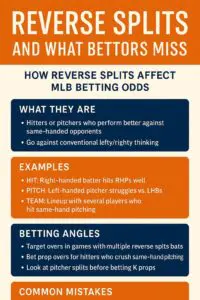
Reverse splits occur when players perform better in ways that go against the usual handedness expectations:
- A right-handed hitter hits better against right-handed pitchers.
- A left-handed pitcher struggles more against left-handed batters.
Even though these trends may start as statistical quirks, when they persist over hundreds of plate appearances or through multiple seasons, they signal real patterns. That’s why recognizing how reverse splits affect MLB betting odds is essential – they can signal mispricing in lines and props.
Why Sportsbooks Rarely Adjust for Reverse Splits
Oddsmakers often rely on broad, conventional splits, because most bettors do. The less intuitive reverse splits don’t trigger much market adjustment, leaving an exploitable gap in how reverse splits affect MLB betting odds:
- A total line might be set low because a righty pitcher faces a righty-heavy lineup.
- But if several hitters in that lineup outperform same-handed pitching, the line is undervalued.
Knowing this helps you anticipate which games or lines are mispriced due to overlooked reverse-split dynamics.
Websites That Let You Track Reverse Splits
Before jumping into examples, here are several tools and platforms where you can find and analyze reverse-split patterns:
Interactive Splits Tool – FanGraphs
FanGraphs offers an advanced “Splits Tool” that lets you apply filters like vs. left-handed or vs. right-handed pitchers – and combine them with batted-ball types, plate-appearance situations, and more.
Splits Leaderboards – FanGraphs
The “Splits Leaderboards” section lets you screen the league – or specific teams – for unusual splits, including reverse ones.
MLB Daily Research Tools – RotoGrinders
RotoGrinders’ daily research tools include player split pages (vs. LHP, vs. RHP), batter-vs-pitcher data, and quick lineup access to explore reverse-split.
Stathead – Baseball-Reference
Stathead (Baseball‑Reference’s premium site) allows “double splits” – for example, April vs. righties – via the Event Finder tool.
ESPN Splits Pages
ESPN includes detailed split breakdowns on its player pages (e.g., vs. LHP vs. RHP, home vs. away), which can be used to spot potential reverse splits.
Examples of Underrated Matchups Bettors Miss
Before listing specific cases, it’s useful to show why examples matter – they turn theory into actionable insight.
Example 1: Hitters Who Crush Same-Handed Pitching
You can use FanGraphs’ Splits Tool or Leaderboards to find hitters who consistently post higher OPS or slugging against same-handed pitchers. Deploy these insights for player prop bets like total bases or home runs.
Example 2: Pitchers With Same-Handed Weaknesses
Some pitchers have historically allowed more offense to same-handed hitters – despite being that same hand themselves.
Example 3: Team-Level Patterns
FanGraphs’ Splits Leaderboards can help identify lineups loaded with hitters who thrive in same-handed matchups. You can leverage that information to target mispriced totals or lines.
How to Exploit Reverse Splits in Betting
Here’s how to convert reverse split data into actionable bets – step by step:
- What to Do:
- Visit FanGraphs, RotoGrinders, or ESPN player pages.
- Pull splits vs. LHP and vs. RHP.
- Identify hitters who have maintained stronger OPS or power metrics against same-handed pitchers across a significant sample.
- Bet overs on hits, total bases, or HRs when they face same-handed opponents.
- Totals and Run Lines
- What to Do:
- Use FanGraphs’ Splits Leaderboards to scan for multiple hitters in a lineup with reverse splits.
- Review the opposing pitcher’s splits (via RotoGrinders or ESPN).
- If the pitcher notoriously struggles vs same-hand, consider betting the over on the game total.
- Cross-check with park factors – some righthanded power hitters fare even better in hitter-friendly parks.
- Pitcher Performance Props (Strikeouts, Outs)
- What to Do:
- Pull a pitcher’s strikeout or contact rate splits vs same-handed hitters.
- If a pitcher’s K-rate drops noticeably vs. matched-handed batters, bet the under on strikeouts.
For career trends, use Stathead to confirm multi-season patterns.

Common Mistakes Bettors Make With Reverse Splits
Avoid these common missteps to maintain a real edge:
- Overreacting to Small Sample Sizes
A short hot streak (e.g., 8-for-20) can mislead. Always use splits backed by larger data sets or multiple seasons.
- Ignoring the Bullpen
Even if the starter shows a reverse split, pay attention to the bullpen’s platoon splits too, since late-game matchups can flip dynamics.
- Disregarding Ballpark Effects
Some parks amplify reverse-split edges – like a short porch that helps same-hand power bats. Adjust your analysis accordingly.
- Relying Only on Past Seasons
Trends change. A pitcher or hitter may adjust mid-career. Use current-season data (via ESPN, FG, Stathead) to confirm ongoing reverse splits.
By steering clear of these traps and utilizing the tools above, you’ll be one of the few bettors truly turning reverse split data into long-term value.
Conclusion
Reverse splits don’t just invert baseball logic – they invert betting logic too. When you understand how reverse splits affect MLB betting odds (and back that insight with tools like FanGraphs, RotoGrinders, ESPN, and Stathead), you uncover mispricing opportunities in player props, totals, and pitcher markets.
Before You Go…
Get Weekly Winning Angles Delivered to You
Enjoy this article? Join the Core Sports Betting newsletter where we break down actionable strategies, betting angles, and real-game insights.
Some of the concepts we touch on each week can evolve into full handicapping systems – the kind you can test, refine, and potentially build into long-term edges.
Simple. Practical. No fluff.
Proven Sports Betting Courses
Looking to go deeper?
Our step-by-step courses are built around structured systems – not guesses or opinions. Each course has been backtested over a minimum of 10 years, giving you a clear understanding of how the strategy has performed over time.
If you’re serious about improving your process, these courses show you exactly how to approach betting with discipline and structure.
Free Betting Calculators to Sharpen Your Edge
Want to make smarter, faster decisions?
Our free tools help you quickly calculate odds, payouts, and true value — without the guesswork.
Try these popular calculators:
- Moneyline Calculator
- Parlay Calculator
- No-Vig Odds Calculator (Find True Odds)
- Kelly Criterion Calculator
→ Visit the Betting Tools Hub to access all calculators
Like this article? Pin it on Pinterest!

More to Explore