Golf tournaments present bettors with a challenge that is different from many other sports. The playing…
How Pass Protection Affects NFL Betting Strategy

Football is often described as a game won in the trenches, and nowhere is that more apparent than in the battle to protect the quarterback. Strong or weak pass protection can shape the rhythm of an entire game, influencing not just the scoreboard but also the betting market. For handicappers and bettors, understanding how pass protection affects NFL betting strategy provides a valuable edge.
In this article, we’ll break down why pass protection matters, whether passing teams or rushing teams are more vulnerable, how to evaluate protection easily without being an offensive line coach, and even explore systems you can apply directly to your wagers. By the end, you’ll see that the quality of an offensive line isn’t just background noise – it’s a central driver of betting value.
Why Pass Protection Matters in Betting
At its core, pass protection is the offensive line’s ability to keep defenders away from the quarterback long enough for a play to develop. The difference between clean pockets and collapsing ones often determines:
- Completion percentages
- Yards per attempt
- Sack totals
- Turnover rates
From a betting perspective, these outcomes directly influence spreads, totals, and player props. For example, if a quarterback consistently enjoys three seconds or more in the pocket, his passing yards and touchdown props are more likely to hit. Conversely, when protection breaks down, offenses stall, leading to unders cashing more frequently.
Think about it this way: if you bet on a pass-heavy team like the Bengals and their offensive line is missing two starters, the likelihood of sacks, hurried throws, and stalled drives increases dramatically. Recognizing these dynamics before the sportsbook fully adjusts can give you an edge.
Passing Teams vs. Running Teams: Who Gets Impacted More?
Not all offenses are equally affected by poor pass protection. The style of play makes a big difference, and bettors who understand this nuance can make smarter wagers.
- Passing-Heavy Teams: These teams rely on consistent quarterback play. When the line falters, every passing prop – from completions to touchdowns – is at risk. Bettors should watch for sack rates and pressure statistics when handicapping teams like Kansas City or Cincinnati.
- Running-Oriented Teams: Teams with strong run games (e.g., Baltimore or Cleveland) can sometimes mask poor pass blocking by leaning on the ground attack. However, they still face issues in obvious passing downs (3rd and long). Bettors may find value betting unders on their quarterback passing props, especially against elite pass rushes.
Key Takeaway
Passing teams are more fragile in the face of poor pass protection, while run-first squads can sometimes offset weaknesses. If you can identify which category a team falls into, you’ll know how much weight to put on protection when analyzing a game.
How to Evaluate Pass Protection Easily
You don’t need to be an NFL scout or subscribe to expensive analytics platforms to evaluate offensive line play. A handful of free or low-cost resources can provide the insights you need.
Before listing these tools, it’s important to explain the reasoning: bettors often shy away from offensive line analysis because it seems technical. But with just a few simple stats, you can quickly gauge whether a team has solid pass protection or glaring holes.
Useful Metrics to Track
Here are the most accessible metrics for bettors and how to use them:
- Sack Rate Allowed
- This measures the percentage of plays that end in a sack. If a team ranks in the bottom five of the league, their QB is under constant pressure.
- How to use it: Fade overs on passing yards and completions props when sack rate is high. Consider unders on team totals as well.
- QB Hits and Pressures Allowed
- Even if sacks don’t occur, frequent hits and pressures can rattle quarterbacks.
- How to use it: Track these week to week. If a team gives up 8–10 QB hits regularly, overs on their passing props become riskier.
- Pass Block Win Rate (PBWR)
- ESPN and Pro Football Focus provide this metric, showing how often linemen sustain their blocks for at least 2.5 seconds.
- How to use it: High PBWR teams are safer for betting overs on QB performance; low PBWR suggests fade opportunities.
- Injury Reports
- Offensive line depth is thin across the NFL. A single injury can move the needle.
- How to use it: Pay close attention to injury reports, especially if multiple starters are out. Sportsbooks may not fully adjust until game day.
By consistently checking these metrics, you’ll quickly spot mismatches between offensive lines and defensive fronts – mismatches that oddsmakers sometimes undervalue.
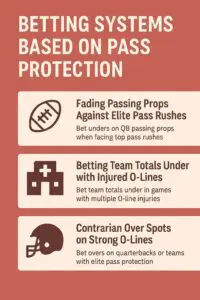
Betting Systems Based on Pass Protection
Once you understand the stats, the next step is building simple systems you can repeat weekly. These systems don’t require complex models; they’re frameworks to filter your bets.
- Fading Passing Props Against Elite Pass Rushes: Bettors often overestimate the stability of star quarterbacks. Even elite QBs struggle when their line collapses. Here’s a simple way to build a system around this.
- Identify teams with low pass block win rates.
- Cross-check their schedule against opponents ranking top-5 in pressures or sack rate.
- Bet unders on QB passing yards or completions props in those matchups.
Why it works: Sportsbooks price props based on season averages, but protection breakdowns create situational disadvantages that aren’t fully priced in.
- Betting Team Totals Under with Injured O-Lines: Offensive line injuries can devastate scoring efficiency. A betting system built around monitoring injuries can be highly profitable.
- Track weekly injury reports for offensive linemen.
- If two or more starters are out, flag the matchup.
- Bet the team total under, particularly against defenses with strong pass rushers.
Example: A 2022 Rams team missing three linemen consistently went under their projected totals despite having an elite QB and wideout.
- Contrarian Over Spots on Strong O-Lines: Just as poor protection creates unders, elite protection often leads to overlooked overs.
- Find teams ranked top-5 in pass block win rate.
- Cross-check against defenses that struggle to generate pressure.
- Bet overs on QB yards, completions, or even team totals when sportsbooks set lines based on average performance.
Why it works: Bettors focus on skill players, not linemen. Strong OL matchups can quietly supercharge offensive stats.

Additional Betting Angles Related to Pass Protection
Beyond systems, there are other creative ways to apply protection insights to betting:
- Live Betting Adjustments: If you notice early sacks and constant pressure, you can hammer live unders before sportsbooks adjust.
- Matchup Specifics: Teams facing blitz-heavy defenses might crumble if their OL isn’t prepared. Conversely, teams with veteran linemen can exploit predictable blitzes.
- Season-Long Trends: Track OL continuity. Units that start together for multiple games tend to improve as the season progresses, offering value on overs later in the year.
Each of these strategies revolves around the same principle: the line’s ability to block determines whether an offense thrives or stalls. Bettors who monitor it have a real advantage.
In Summary
Offensive line play might not generate highlight reels, but it absolutely shapes the outcome of football games – and betting slips. By understanding how pass protection affects NFL betting strategy, you can identify mismatches, avoid overvaluing star quarterbacks in tough situations, and capitalize on overlooked angles in totals and props.
The next time you scan the betting board, don’t just look at quarterbacks, running backs and wide receivers. Look at the big men up front. Their ability (or inability) to protect may be the hidden key to profitable NFL betting.
Before You Go…
Get Weekly Winning Angles Delivered to You
Enjoy this article? Join the Core Sports Betting newsletter where we break down actionable strategies, betting angles, and real-game insights.
Some of the concepts we touch on each week can evolve into full handicapping systems – the kind you can test, refine, and potentially build into long-term edges.
Simple. Practical. No fluff.
Proven Sports Betting Courses
Looking to go deeper?
Our step-by-step courses are built around structured systems – not guesses or opinions. Each course has been backtested over a minimum of 10 years, giving you a clear understanding of how the strategy has performed over time.
If you’re serious about improving your process, these courses show you exactly how to approach betting with discipline and structure.
Free Betting Calculators to Sharpen Your Edge
Want to make smarter, faster decisions?
Our free tools help you quickly calculate odds, payouts, and true value — without the guesswork.
Try these popular calculators:
- Moneyline Calculator
- Parlay Calculator
- No-Vig Odds Calculator (Find True Odds)
- Kelly Criterion Calculator
→ Visit the Betting Tools Hub to access all calculators
Like this article? Pin it on Pinterest!

More to Explore