Golf tournaments present bettors with a challenge that is different from many other sports. The playing…
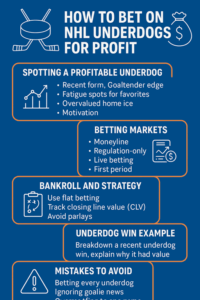
How to Bet on NHL Underdogs for Profit

In sports betting, few opportunities offer as much hidden value as NHL underdogs. While most bettors gravitate toward favorites, savvy handicappers know that dogs often bite – and they can bite hard. Understanding how to bet on NHL underdogs for profit is about more than picking random teams with plus money odds. It requires a strategy rooted in data, context, and timing. In this article, we’ll break down exactly how to find value on NHL underdogs, what makes the NHL unique for underdog betting, and how to turn public perception into profit.
Why NHL Is Underdog-Friendly
The NHL is one of the most variance-heavy sports in North America. Unlike basketball, where the better team wins more often due to the sheer volume of scoring, hockey is a low-scoring sport decided by inches – and sometimes luck. This unpredictability gives underdog teams a much better chance of winning outright, making NHL betting one of the few sports where underdogs can offer long-term profit potential.
Several key factors contribute to this dynamic:
- High Goalie Impact: A hot goalie can single-handedly shut down even elite teams.
- Low-Scoring Nature: Fewer goals = more randomness.
- Parity Between Teams: Salary caps and draft rules create balanced rosters.
- Public Bias Toward Favorites: Recreational bettors inflate favorite prices, creating inflated underdog lines.
These ingredients create an environment where learning how to bet on NHL underdogs for profit can give you an edge if you know what to look for.
Spotting a Profitable NHL Underdog
Before you blindly bet the next team listed at +180, understand that not all underdogs are worth your money. Some are priced correctly or even offer negative expected value. The goal is to spot when an underdog is undervalued relative to their chances of winning. Here’s how to do that:
Key Factors to Consider
To help you consistently identify the right NHL underdogs, here’s a list of criteria and how to apply them effectively:
- Recent Form vs. Season Record
Many bettors rely too heavily on full-season stats, but often enough hockey is momentum-driven. An underdog riding a hot streak may be undervalued if their season record is mediocre.
How to do it:
Check the last 5–10 games. Use NHL.com or sites like NaturalStatTrick.com to review shot share (Corsi/Fenwick), goal differential, and special teams performance during that span.
- Goaltender Edge
Few things swing NHL betting outcomes like goaltending. A team with an elite or red-hot goalie can steal a game – even as a big dog.
How to do it:
Track confirmed starters on DailyFaceoff.com. Look at Save % and Goals Saved Above Expected (GSAx) from MoneyPuck.com. Bet on underdogs with above-average goalies, especially against backup goalies on favorites.
- Back-to-Back or 3-in-4 Spots for Favorites
Favorites playing tired can be vulnerable, especially against rested underdogs.
How to do it:
Look at schedule density. Bet on underdogs playing against teams on the second night of a back-to-back or 3rd game in 4 nights. These spots increase fatigue and lower favorite performance.
- Overvalued Home-Ice Advantage
Books and the public often overrate home ice in hockey. While playing at home helps, the advantage isn’t as strong as in other sports.
How to do it:
Fade weak home teams who are still getting heavy lines as favorites. Look at home/road splits and expected goals at 5v5.
- Motivation and Intangibles
Not all games are created equal. A team fighting for a playoff spot will likely bring more effort than a team eliminated from contention.
How to do it:
Monitor the standings. Avoid betting underdogs who are tanking or resting stars. Bet on teams with something to play for, especially late in the season.
Betting Markets That Favor Underdogs
Most people think of betting underdogs as just taking them on the moneyline. While that’s often the best play, there are a few different market types that can help maximize your profits when betting NHL dogs.
Before diving into specific betting formats, it’s important to understand how market types can drastically change your risk and reward profile.
- Moneyline (Best for Value)
This is the cleanest way to bet an underdog – bet them to win the game outright.
How to do it:
If a team is +150, a $100 bet returns $150 in profit. You only need the underdog to win 40% of the time to be profitable at that number.
- Regulation-Only (3-Way Line)
Some sportsbooks offer odds for a team to win in regulation. This market excludes OT or shootout.
How to do it:
If you believe the underdog will win in 60 minutes, you’ll get an even better price than the full-game moneyline. Be cautious though—this adds more risk.
- Live Betting
Live betting gives you an opportunity to get better value after watching the flow of the game.
How to do it:
If an underdog falls behind early but is outshooting or dominating puck possession, consider live betting them at an even better price (e.g., +250 after going down 1-0).
- First Period Bets
If an underdog has strong opening period stats (shots, goals, possession), you can find value in first period bets.
How to do it:
Look for underdogs with high 1st period xGF (expected goals for) numbers. Bet them to win the 1st period or be leading after 20 minutes.

Bankroll and Strategy Tips for Underdog Bettors
Profitable underdog betting is not just about picking winners – it’s also about managing your money wisely. Here’s how to build a sustainable approach:
Before jumping into tips, remember: bankroll discipline is especially important with underdogs, where win rates are lower but payouts are higher.
- Flat Betting
Instead of varying your bet sizes, wager the same amount on each underdog bet.
Why it works:
It protects you from variance. Even if you go 3–7 in your last 10 bets at +150 average odds, you’re still profitable.
- Track Your Closing Line Value (CLV)
This shows whether you’re beating the market consistently.
How to do it:
Record the line you bet and the closing line from your sportsbook. If your underdog bets close at shorter odds than you bet them (e.g., bet +160, closes +145), that’s a good sign you’re beating the market.
- Avoid Parlays with Underdogs
While tempting, parlays significantly reduce your long-term edge – especially with underdogs.
Why to avoid:
Underdogs have lower win probabilities. Chaining them together in parlays might give a huge payout, but your hit rate will drop drastically.
Mistakes to Avoid When Betting NHL Underdogs
While there’s great value in underdog betting, there are also pitfalls that can ruin your edge. Here are common mistakes – and how to steer clear of them.
Avoid These Errors
Before rushing into your next NHL dog bet, take a step back and ensure you’re not making these costly errors:
- Blindly Betting Every Underdog
Not every dog is undervalued. You need an edge or signal for each bet. - Ignoring Goalie News
Starting goalies affect lines dramatically. A surprise backup can change everything. - Overreacting to One Game
One fluke win doesn’t make a trend. Focus on repeatable factors like xG, shot share, and special teams. - Lack of Line Shopping
Getting +160 instead of +145 can significantly impact your ROI over a season. Use multiple books.
Conclusion
Mastering how to bet on NHL underdogs for profit comes down to understanding where the market misprices teams – and why. With a mix of data analysis, situational awareness, and disciplined bankroll management, NHL underdogs can become one of the most rewarding betting angles in any sport. The key isn’t in betting every dog – it’s in betting the right ones.
Start tracking your results, watching line movement, and building models around goalie performance and rest disadvantages. The more disciplined your process, the more those underdogs will bark in your favor.
Before You Go…
Get Weekly Winning Angles Delivered to You
Enjoy this article? Join the Core Sports Betting newsletter where we break down actionable strategies, betting angles, and real-game insights.
Some of the concepts we touch on each week can evolve into full handicapping systems – the kind you can test, refine, and potentially build into long-term edges.
Simple. Practical. No fluff.
Proven Sports Betting Courses
Looking to go deeper?
Our step-by-step courses are built around structured systems – not guesses or opinions. Each course has been backtested over a minimum of 10 years, giving you a clear understanding of how the strategy has performed over time.
If you’re serious about improving your process, these courses show you exactly how to approach betting with discipline and structure.
Free Betting Calculators to Sharpen Your Edge
Want to make smarter, faster decisions?
Our free tools help you quickly calculate odds, payouts, and true value — without the guesswork.
Try these popular calculators:
- Moneyline Calculator
- Parlay Calculator
- No-Vig Odds Calculator (Find True Odds)
- Kelly Criterion Calculator
→ Visit the Betting Tools Hub to access all calculators
Like this article? Pin it on Pinterest!

More to Explore