One of the most visible physical differences between fighters inside the UFC octagon is reach. When…
Understanding the Favorite-Longshot Bias in Sports Betting

Sports betting is full of nuances and patterns, but one psychological phenomenon has stood the test of time: understanding the favorite-longshot bias in sports betting. This bias refers to a consistent tendency among bettors to overvalue longshots and undervalue favorites, leading to inefficient markets and poor decision-making – especially for casual or recreational players.
In this article, we’ll break down exactly what the favorite-longshot bias is, why it persists across different sports, and most importantly, how you can use this knowledge to make smarter bets. If you’re serious about beating the books, understanding the favorite-longshot bias in sports betting is one of the first steps toward developing a sharper edge.
What Is the Favorite-Longshot Bias?
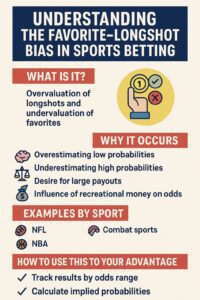
Let’s begin by defining the concept in simple terms. The favorite-longshot bias is a well-documented betting phenomenon where bettors overbet longshots (teams or players with low chances of winning and high payouts) and underbet favorites (those expected to win, with lower payouts). This means that:
- Favorites tend to win more often than their odds suggest, making them slightly undervalued.
- Longshots lose more often than their odds suggest, making them slightly overvalued.
This bias has been observed for decades across sports and even in casino settings like horse racing. It’s not a fluke – it’s a pattern fueled by human psychology and the desire for big payouts.
Why Does This Bias Exist?
Before we jump into examples or strategies, it’s important to understand why the favorite-longshot bias happens. It’s not just poor decision-making – it’s a blend of mental shortcuts, emotional desire, and how sportsbooks set lines. Below, we’ll explore the key drivers behind the bias.
What Drives the Favorite-Longshot Bias?
Each of the reasons listed below is a piece of the puzzle. Together, they explain why bettors continuously fall into this trap – even when the math tells a different story.
1. Overestimation of Low Probabilities
Humans are naturally poor at estimating very small probabilities. When a team has a 5% chance of winning, bettors might emotionally interpret that as “worth a shot,” when in reality, it may only be worth a wager at +2000 odds – but sportsbooks offer just +1500.
What this means for you: Avoid betting just because the odds are large. Instead, compare the actual implied probability of the odds to your own projection of win probability.
2. Underestimation of High Probabilities
Favorites might win 65% or 70% of the time, but bettors don’t like risking a lot for a small gain. A -300 favorite might win far more often than a +250 underdog, but it feels “risky” to bet big for small returns.
How to counteract this: Focus on expected value (EV), not just payout. A consistent winner at -300 can be more profitable long-term than chasing +400 longshots.
3. The Lottery Mindset
Bettors enjoy the thrill of a big win. It’s the same reason people play the lottery – despite terrible odds. The allure of turning $10 into $100 is more emotionally satisfying than a $10 bet that wins $3.33 – even if the latter is the better bet.
What to do instead: Recognize that slow, steady profit beats occasional big wins with frequent losses. Train yourself to value winning percentages over potential jackpots.
4. Influence of Recreational Money on Odds
Oddsmakers account for public behavior. If recreational bettors keep pouring money on longshots, the odds shift to protect the books. This means favorites can become even more valuable than their true odds indicate.
How you can benefit: Fade the public. If an underdog is popular and the line moves, check if the favorite now offers +EV based on your model or projections.
Horse Racing: The Origin of the Bias
One of the first places this bias was studied was in horse racing. In a famous study by Thaler and Ziemba, bettors consistently lost more money on longshots than favorites – even though payouts were higher.
Lesson: Even when payouts are flashy, longshots underperform. Over thousands of bets, backing longshots becomes a losing proposition.
Combat Sports: Underdogs and the Hype Effect
In UFC or boxing, underdogs often get hyped up due to trash talk, highlight reels, or fan loyalty. But the sportsbooks rarely misprice these fights. For example, when Conor McGregor fought Khabib Nurmagomedov, tons of bets poured in on McGregor at +160 or more.
Outcome? Khabib dominated. McGregor’s popularity skewed the public perception, but the sharp bettors profited by fading the hype.

What the Data Tells Us
To solidify our understanding, let’s examine real data that shows the favorite-longshot bias is measurable and consistent.
Historical Betting Studies
A famous 1979 study by Richard Thaler found that bettors lost:
- About 5% on favorites
- Up to 40% on extreme longshots
That’s a massive difference and shows how overvaluing longshots leads to bigger long-term losses.
Modern Bookmaker Data
Books like Pinnacle and Betfair have released insights confirming:
- Sharp money often comes in on favorites
- Recreational bettors push longshot lines further from true value
- Underdogs with +400 or longer lose more than the implied odds suggest
This backs up everything we’ve said: the bias is predictable and exploitable.
How to Use This Knowledge to Your Advantage
Understanding the favorite-longshot bias in sports betting gives you the power to recognize when others are betting with emotion, not math. Below is a list of actionable strategies you can use.
Practical Tips to Beat the Bias
Before diving into the list, let’s highlight one important idea: It’s not about avoiding all longshots – it’s about recognizing when odds are mispriced.
- Track Your Results by Odds Range
Use a spreadsheet to log each bet’s odds and outcome. Over 100+ bets, check whether you’re profitable on +300 or higher bets vs -200 or lower. This helps reveal if you’re falling victim to the bias. - Calculate Implied Probabilities
Convert odds to implied probability. For example, +300 = 25% chance. Ask yourself honestly – does the underdog really win 1 out of 4 times here? If not, pass. - Look for Value Favorites
Value doesn’t just exist in longshots. If a team is -180 but should be -220, that’s a value favorite – consider betting it. Look for small inefficiencies, not home runs. - Fade Popular Longshots in Big Events
Public money floods in on underdogs during the Super Bowl, UFC title fights, or March Madness. Let the crowd drive the line up – then bet the favorite. - Study Closing Line Value (CLV)
If you consistently beat the closing line with your favorites, you’re doing it right. Tracking CLV over time is a great proxy for edge.
Conclusion
At its core, understanding the favorite-longshot bias in sports betting is about recognizing a recurring trap that catches countless bettors. This bias is real, repeatable, and documented across sports and decades of data. It’s fueled by our psychological weaknesses – hope, greed, and misunderstanding of probability.
If you want to improve your long-term betting performance, start paying attention to the value in favorites and be skeptical of “sexy” longshots. Profit comes not from glory bets, but from smart, consistent wagers where the math is on your side.
Like this article? Pin it on Pinterest!

More to Explore