One of the most visible physical differences between fighters inside the UFC octagon is reach. When…
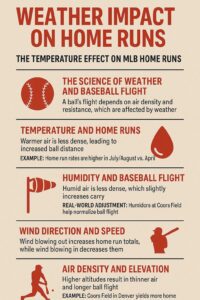
The Temperature Effect on MLB Home Runs

Baseball is often called a game of inches, but when it comes to home runs, those inches quickly add up to feet – and those extra feet can be the difference between a routine fly out and a ball sailing over the fence. What makes it more interesting is that those extra feet aren’t always about the swing or the hitter’s strength. They can be influenced by something players can’t control – the weather.
One of the biggest hidden variables is how temperature interacts with the flight of the baseball. In fact, the temperature effect on MLB home runs has been studied for years, and the data confirms what players and fans sense: warmer air tends to boost offense, while cooler air suppresses it.
This article breaks down exactly how temperature – along with other weather factors like humidity, wind, and air density – affects home runs. We’ll cover the science, show real examples, and explain how you can use this knowledge whether you’re betting, setting fantasy lineups, or just watching games.
The Science Behind Weather and Baseball Flight
Before digging into temperature specifically, it’s important to understand why weather matters in the first place. A baseball’s flight depends on the interaction between the ball, the bat, and the air it travels through. The denser the air, the more resistance the ball encounters.
Think of swinging a baseball bat underwater: the thicker the medium, the harder it is for the ball to move freely. In the air, this same principle applies but on a much smaller scale. Weather changes the density of air, and even small variations can add or subtract several feet of carry. A ball hit to the warning track in April might clear the fence in July – all because of atmospheric conditions.
Temperature and Home Runs
Among all weather variables, temperature is the most straightforward to understand. Warmer air is less dense than cooler air. Less dense air means less drag on the baseball, allowing it to travel farther. That’s the temperature effect on MLB home runs in its simplest form.
Studies by physicists and baseball analysts show that every 10°F increase in temperature can add 1–2 feet of distance to a well-hit fly ball. That might not sound like much, but remember how many balls die at the warning track. A slight boost can turn a deep fly out into a home run.
- Example: In hot summer months (June through August), home run rates across MLB consistently trend upward.
- Example: A game played at 90°F in Texas often features more long balls compared to a chilly April night at 45°F in Minnesota.
This is why summer slugfests are common, and why betting markets and fantasy players pay special attention to forecasts.
Humidity and Baseball Flight
Humidity is one of the most misunderstood factors in baseball weather. Many assume that “thicker” humid air would slow the ball down, but the opposite is true. Water vapor is lighter than the nitrogen and oxygen it replaces in the air, which means humid air is actually less dense than dry air.
That makes humid conditions slightly more favorable for home runs. However, the effect isn’t as strong as temperature. A hot, humid day might add a few feet to fly balls, while a cold, dry day will suppress them.
Real-world adjustment: MLB has acknowledged humidity’s impact by introducing humidors for baseball storage. For example:
- At Coors Field in Denver, a humidor was introduced to reduce the crazy home run totals caused by thin air and dry conditions.
- Other parks in dry climates, like Arizona, also use humidors to normalize flight.
This shows how seriously teams take weather and ball storage when it comes to controlling game outcomes.
Wind Direction and Speed
Temperature is critical, but wind can make an even more dramatic difference on any given night. A 10–15 mph wind blowing out to center can turn a low-scoring ballpark into a launching pad. On the other hand, that same wind blowing in can crush scoring potential.
It’s worth noting that some stadiums are particularly sensitive to wind because of their design.
- Wrigley Field (Chicago): Perhaps the most famous example, where winds howling out to left field can create home run derbies, and winds blowing in make it nearly impossible to clear the fence.
- Oracle Park (San Francisco): Known for swirling winds that knock balls down before they reach McCovey Cove.
How to apply this as a fan or bettor: Always check wind direction in game previews. If the forecast shows wind blowing out, totals (over/unders) are often adjusted upward by sportsbooks. Some handicappers look for opportunities before lines shift too much.
Air Density and Elevation
While temperature and humidity change air density day-to-day, elevation creates a permanent baseline. Higher elevation means thinner air, which equals longer ball flight.
- Coors Field (Denver, 5,200 feet above sea level): The poster child for elevation’s impact. Home run rates are significantly higher, leading to inflated offensive stats.
- Petco Park (San Diego, sea level): One of the more pitcher-friendly parks, thanks to heavy marine air and low elevation.
Analysts often refer to an Air Density Index (ADI), which combines temperature, humidity, and elevation into a single number that predicts ball flight conditions. While not an official MLB stat, it’s a tool bettors and fantasy players can use to anticipate HR-friendly environments.

Practical Applications: Fans, Bettors, and Fantasy Players
Now that we’ve covered the science, let’s talk about how to actually use this information. Weather effects on baseball aren’t just trivia – they’re actionable insights.
Here are three groups who benefit most:
- Fans at the Ballpark
When you’re heading to a game, check the weather:
- If it’s a hot July day with light winds blowing out, expect fireworks.
- If it’s cold with winds blowing in, settle in for a pitcher’s duel.
This makes the experience more predictable and engaging.
- Sports Bettors
For bettors, the temperature effect on MLB home runs is a real edge. Sportsbooks adjust totals for weather, but not always perfectly. To apply this:
- Step 1: Before betting a total (over/under), check the forecast for temperature and wind.
- Step 2: Compare it to the stadium’s usual run environment (Coors vs Petco, for example).
- Step 3: If conditions strongly favor home runs (hot day, wind out), look at overs before the line moves. If conditions suppress them (cold night, wind in), unders may have value.
- Fantasy Baseball Players
Weather also matters in daily fantasy sports. To use this insight:
- When selecting hitters, prioritize players in hot-weather games with wind blowing out.
- Avoid power hitters in cold, damp conditions where the ball won’t carry.
- Some fantasy tools even list “ballpark factors” for the day, including weather-adjusted projections.
Example: Temperature’s Direct Influence
To illustrate, consider these two scenarios:
- Game A: A 70°F game in New York, no wind. A 400-foot drive clears the fence.
- Game B: Same batter, same swing, but it’s 45°F. That same ball may travel 395 feet and die at the warning track.
That’s only five feet difference – but it’s the difference between a highlight-reel home run and an inning-ending fly out.
Conclusion
Weather is one of the silent forces shaping baseball outcomes, and nowhere is this clearer than with temperature. The temperature effect on MLB home runs shows us that the warmer the day, the better the chances a fly ball finds the seats. Combine that with humidity, wind, and elevation, and you have a recipe for games that can look completely different despite the same players being on the field.
Like this article? Pin it on Pinterest!

More to Explore