One of the most visible physical differences between fighters inside the UFC octagon is reach. When…
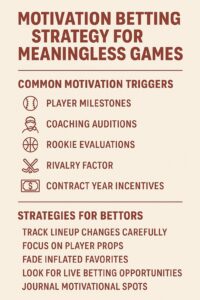
Motivation Betting Strategy for Meaningless Games

I’ll admit something right up front: I personally don’t tend to wager much at the end of the season. Once playoff spots are determined, the dynamics of games change dramatically. Star players rest, coaches experiment with different lineups, and teams that are already out of contention often look like they’re just going through the motions. From my perspective, this makes late-season games some of the hardest to handicap.
But that doesn’t mean there’s no value to be found. In fact, some bettors thrive on this chaos because the markets don’t always price motivation correctly. That’s where a motivation betting strategy for meaningless games comes into play. By digging deeper into which players or teams actually have something left to play for, you can uncover opportunities that the average bettor (and sometimes even the oddsmakers) overlook.
In this article, we’ll break down why motivation matters, the most common motivational triggers you should look for, real-world examples of how it’s played out in the past, and step-by-step strategies you can use to profit during the strangest weeks of the sports calendar.
Why Motivation Matters in Betting
Sports betting is often about numbers – statistics, odds, and trends – but late in the season, psychology and situational context can be just as important. A team that is locked into a playoff seed may care little about winning or losing a particular game. On the other end, a team that has no chance at the postseason might suddenly play their hardest when facing a rival, or when one of their young players is chasing a milestone.
The oddsmakers set lines based on expected motivation, but they’re not perfect. Lines are heavily influenced by the betting public as well, and the public often assumes that “meaningless” means “no effort.” That’s not always the case, and spotting those moments where motivation levels are mispriced is where sharp bettors find an edge.
Think of it this way: talent matters, but effort is the multiplier. A talented team giving 60% might lose outright to an average team playing at 110%. That imbalance is where the motivation betting strategy for meaningless games becomes powerful.
Common Motivation Triggers in “Meaningless” Games
Before diving into examples, it’s important to understand the kinds of situations that can keep players and teams motivated even when standings say otherwise. These triggers are the foundation of finding late-season betting value.
Here are some of the most common motivational factors, explained in detail:
- Player Milestones
When a player is chasing a personal milestone – such as 30 home runs in baseball, 1,000 rushing yards in football, or a scoring title in basketball – they often continue to play hard even when the team isn’t contending. To use this in your betting, track news and beat reports to see if a coach is emphasizing helping that player reach the milestone. Betting their individual player props (like hits, receiving yards, or points scored) can often be more profitable than betting the team side. - Coaching Auditions
Interim coaches or assistants with something to prove may push their players to perform even in meaningless games. For example, if a head coach was fired mid-season, the interim leader may use these games as an extended job interview. Bettors who notice these scenarios early can capitalize on teams playing “above expectations.” - Rookie Evaluations
Teams out of contention often give more playing time to rookies or bench players to evaluate their potential. This can cut both ways: young players may be highly motivated to prove themselves, but they’re also inexperienced and inconsistent. If you’re betting on games like this, it might be better to focus on prop markets (e.g., rookie scoring totals) rather than full-game outcomes. - Rivalry Factor
Even meaningless games can carry meaning against a rival. Think of a last-place NFL team knocking off a playoff-bound division opponent just for pride. In these spots, the underdog often plays harder than the line suggests. - Contract Year Incentives
Players heading into free agency or a contract negotiation have every reason to pad their stats late in the year. They want to show durability, effort, and strong numbers. Sports betting models that only account for season averages might undervalue these late surges, creating betting opportunities on individual props.
Each of these triggers represents a specific lens you can apply to late-season games. The more of these factors align for a particular team or player, the more value there is in considering a bet.
Historical Examples of Motivation Edges
To illustrate how this works in practice, let’s look at a few examples across different sports.
- MLB September Call-Ups
Every September, when rosters expand, teams bring up minor league prospects for evaluation. These players often bring a burst of energy, and teams that looked lifeless suddenly put up strong offensive performances. In 2019, the Blue Jays surged late in the season behind young hitters like Bo Bichette and Cavan Biggio. They weren’t playoff contenders, but they consistently covered run lines against better teams. - NBA Resting Stars
Playoff-bound NBA teams frequently rest their starters in the last week of the regular season. In 2022, the Milwaukee Bucks sat Giannis Antetokounmpo in multiple games, and their opponents – who still had motivation to finish strong – not only covered but won outright as underdogs. - NFL Spoiler Teams
Week 17 (and now Week 18) in the NFL is full of surprises. In 2020, the New York Jets, long eliminated from playoff contention, played spoiler against the Cleveland Browns. Cleveland was favored, but the Jets – fueled by younger players trying to keep jobs – pulled off the upset. Bettors who recognized the motivational edge cashed in.
These examples prove that while the games may be meaningless in the standings, they are not meaningless in the betting markets. This is the essence of a motivation betting strategy for meaningless games.
Strategies for Bettors
Now that we’ve identified why motivation matters and what triggers to look for, let’s turn it into a practical strategy. Here’s how you can apply these ideas step by step.
- Track Lineup Changes Carefully
Don’t just glance at injury reports. Read team beat writers, check Twitter, and listen for coach quotes. If a playoff team announces they’re resting starters, that’s a signal to consider the underdog or the total. - Focus on Player Props
Late in the season, team effort may be inconsistent, but individual goals remain strong. If you know a wide receiver needs 40 more yards for a season milestone, betting the “over” on his yardage prop may be smarter than betting his team to win. - Fade Inflated Favorites
Public bettors often hammer playoff teams, assuming they’ll dominate weaker opponents. Books inflate these lines to account for that bias. This creates value on the underdog – especially when that underdog has one of the motivational triggers we discussed. - Look for Live Betting Opportunities
Motivation is sometimes clearest once the game starts. If you notice a team is playing hard despite being out of contention, live betting allows you to capitalize before oddsmakers fully adjust. - Journal Motivational Spots
Keep a log of games where motivation (or lack thereof) played a role. Over time, you’ll spot patterns that help refine your betting instincts. For example, you might notice that divisional underdogs with nothing to lose often cover at a higher rate.
Each of these strategies works best when combined. Don’t rely on just one factor; instead, stack motivations and use them to identify mispriced markets.

Risks and Pitfalls
Of course, there are no guarantees. Motivation is one of the hardest factors to quantify. A coach might promise to play the starters but pull them at halftime. A team might look motivated during warm-ups but check out after falling behind early.
The key is discipline. Even with a motivation betting strategy for meaningless games, you should avoid over-betting these scenarios. Keep your bankroll rules intact, and remember that sportsbooks are also watching for these edges. The lines can move fast once motivational angles become public knowledge.
Conclusion
End-of-season games can feel like a minefield for bettors, but with the right approach, they can also be a source of hidden value. A motivation betting strategy for meaningless games is about looking past the standings and digging into the human side of sports – pride, milestones, contracts, rivalries, and auditions. By recognizing when effort doesn’t match public perception, you can spot opportunities that others miss.
For me personally, I may still shy away from these games, but I know that sharp bettors who put in the research can gain an edge when others see only chaos. If you’re willing to track motivation triggers, stay disciplined, and think beyond the surface, the “meaningless” part of the season might just become one of the most profitable.
Like this article? Pin it on Pinterest!

More to Explore