One of the most visible physical differences between fighters inside the UFC octagon is reach. When…
How to Find Historical Edge in Prop Betting

Prop betting has exploded in popularity across sports, from NFL rushing attempts to NBA three-pointers to MLB strikeouts. Unlike sides and totals, props often fly under the radar, making them a goldmine for disciplined bettors who know how to look for repeatable patterns. If you’ve ever wondered how to find historical edge in prop betting, this article is for you. Let’s break it down step by step.
What Is a Historical Edge in Prop Betting?
Before diving into examples, it’s important to define what we mean by a “historical edge.” In simple terms, a historical edge is a repeatable advantage found by analyzing past performance data and identifying situations where the market has mispriced the outcome.
For example, imagine an NBA guard who averages 8 assists per game against bottom-10 defenses but only gets posted with a line of 6.5 assists. If this pattern has held for multiple seasons, that’s a historical edge – a spot where the actual outcome has consistently exceeded the posted line.
Historical edges are powerful because they are based on long-term data rather than short-term hunches. While a single game can swing in unexpected ways, bettors who focus on historical tendencies build an advantage rooted in probabilities. That’s exactly why learning how to find historical edge in prop betting is so valuable – it turns what feels like guesswork into a repeatable strategy.
Why Historical Data Matters for Props
Unlike spreads and totals, prop markets often lag behind in efficiency. Sportsbooks can’t sharpen every single prop line as aggressively as they do for sides because there are simply too many of them. That leaves opportunities for disciplined bettors.
For instance:
- NBA rebounds by position: Centers facing smaller lineups might consistently go over their rebound props.
- NFL QB passing attempts: Quarterbacks on underdog teams often throw more, hitting overs more frequently than expected.
- MLB stolen bases: Speedy players may rack up steals against catchers with poor throw-out rates.
The beauty of historical data is that it reveals these patterns over time. One game doesn’t mean much. Ten or twenty games against similar opponents, however, start to show whether a betting edge exists.
If you’ve been wondering how to find historical edge in prop betting, the answer lies in identifying these situations, tracking them over the long term, and betting them only when they show clear repeatability.
Where to Find Historical Prop Data
Before we can use data, we need to know where to get it. There are several free and paid resources that can help you collect and analyze prop-related stats.
Here are a few of the best options:
- Pro-Football-Reference, Basketball-Reference, Baseball-Reference: These free databases provide player game logs that you can export to spreadsheets. You can track passing attempts, rebounds, strikeouts, and more.
- Stathead (paid upgrade): Offers deeper filters, such as “performance as underdog” or “games against top-10 defenses.” This is powerful for slicing data into meaningful betting angles.
- Odds-tracking sites: Some websites archive past betting lines and closing odds, which can be matched against player performance.
To use these effectively:
- Pick a player prop market you want to study (example – MLB pitcher strikeouts).
- Export game logs into a spreadsheet.
- Match the actual stat against the posted line (if archived) or compare to average sportsbook numbers.
- Look for repeatable patterns, such as pitchers who consistently outperform strikeout lines against certain lineups.
This step requires effort, but it’s also the foundation of how to find historical edge in prop betting. Without reliable data, you’re just guessing.
Step-by-Step: Building a Historical Edge for Props
It’s one thing to talk about analyzing data – it’s another to have a clear process. Below is a step-by-step framework for building your own historical edge in prop betting. Each step builds on the last, and skipping steps can lead to false conclusions.
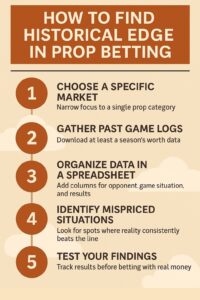
Step 1: Choose a Specific Market
Don’t try to analyze every prop type at once. Pick one category, such as NBA assists props or NFL rushing attempts. By narrowing your focus, you can develop expertise faster.
Step 2: Gather Past Game Logs
Download at least one season’s worth of data, though multiple seasons are better. Look for stats directly tied to the prop market (rebounds, assists, passing attempts, etc.).
Step 3: Organize Data in a Spreadsheet
Create columns for opponent, game location, game situation (favorite/underdog, pace, etc.), and result vs posted line. The goal is to track not just what happened, but under what circumstances it happened.
Step 4: Identify Mispriced Situations
Look for instances where the player consistently outperforms or underperforms the sportsbook line. For example:
- Player averages 10 rebounds against fast-paced teams but only 7.5 against slow-paced teams.
- QB throws 35+ attempts when underdog but only 25 attempts when favored.
Step 5: Test Your Findings
Instead of immediately betting large amounts, track results on paper for several weeks. See if the historical edge continues to show in real time. Only once you’re confident in the repeatability should you invest real bankroll.
This process may sound tedious, but it’s the very core of how to find historical edge in prop betting. It transforms betting from speculation into research-driven decision-making.
Real Examples of Historical Edges in Props
To see how this works in practice, let’s walk through some common examples where historical edges can be found.
Example 1: NFL Running Back Rushing Attempts
- Pattern: RBs on teams favored by 7+ points often exceed their rushing attempt props.
- Why it Works: Winning teams run more in the second half to control the clock.
- How to Use It: Track RBs in games with spreads of -7 or more. Compare actual rushing attempts vs the posted line. If historical data shows consistent overs, this can be a profitable angle.
Example 2: MLB Pitcher Strikeout Props
- Pattern: Certain pitchers consistently beat strikeout lines against teams with high strikeout rates.
- Why it Works: Matchups matter. A strikeout-heavy lineup inflates opportunities.
- How to Use It: Maintain a log of team strikeout rates by month. Match pitchers against high-K teams and note if they outperform their prop line more often than not.
Example 3: NBA Three-Point Props
- Pattern: Players facing defenses that allow above-average 3-point attempts per game often go over their prop lines.
- Why it Works: Defensive scheme directly affects opportunity.
- How to Use It: Compare 3PA allowed by team vs individual shooter prop lines. Target overs in favorable matchups.
These are just examples, but they illustrate the larger point: how to find historical edge in prop betting comes down to tracking consistent mismatches between reality and sportsbook numbers.

Risks and Limitations of Historical Edges
It’s important to recognize that even the best historical edge can fade. Sportsbooks adjust, players change roles, and coaching strategies evolve.
Some key risks include:
- Small Sample Sizes: Ten games may look like a trend, but it may not hold up over 100.
- Market Adjustment: Once a trend becomes public, sportsbooks will move the lines.
- Unpredictable Variables: Injuries, weather, and coaching decisions can derail historical expectations.
That’s why no system is foolproof. The goal isn’t perfection – it’s building a repeatable advantage that works often enough to be profitable over the long run.
Bankroll Management for Prop Bettors
Even with a strong edge, bankroll discipline is essential. Props can be volatile, and variance will test your patience.
Here’s how to manage it:
- Flat Betting: Wager the same small unit on every prop (e.g., 1% of bankroll). This keeps variance in check.
- Stop-Loss Rule: Decide beforehand how much of your bankroll you’re willing to risk in a single session. For example, a 10% cap prevents catastrophic losses.
- Selective Betting: Only bet props where you have a proven edge of at least 5–10%. Passing on weak edges is just as important as betting strong ones.
By following these rules, you protect yourself from the emotional swings of prop betting and keep your edge sustainable.
Conclusion
Finding an edge in sports betting isn’t about luck—it’s about preparation. Historical prop analysis gives you a way to uncover repeatable advantages that casual bettors and even sportsbooks sometimes overlook.
If you’ve been asking yourself how to find historical edge in prop betting, the answer is simple but not easy: gather data, track patterns, test your theories, and manage your bankroll with discipline.
Like this article? Pin it on Pinterest!

More to Explore