Age is one of the easiest statistics to find when researching a boxing match, but it…
Sports Betting Drawdown: How to Prepare for Losing Streaks Without Changing a Good System
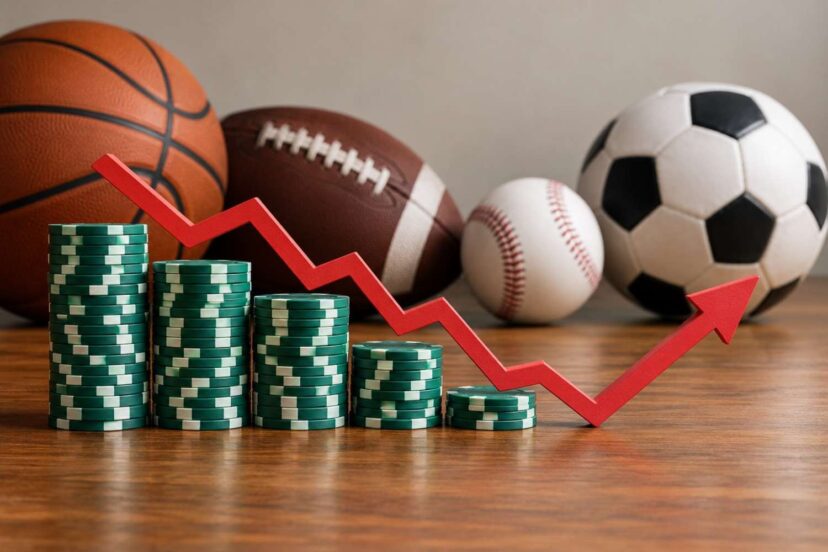
Winning sports bettors do not necessarily avoid losing streaks. In fact, anyone who places enough wagers will eventually experience periods when seemingly good bets repeatedly lose. The important question is not whether those periods will occur, but whether your bankroll and betting process are prepared for them. A sports betting drawdown measures the decline from a previous bankroll or profit peak, and understanding this concept can help bettors separate normal short-term variance from evidence that a strategy may actually need to be reevaluated. Preparing for drawdowns before they happen can also reduce one of the biggest dangers in systematic betting: changing a potentially good strategy simply because recent results have been disappointing.
What Is a Sports Betting Drawdown?
A drawdown is the decline from a previous high point in your bankroll to a subsequent low point before a new high is reached. It provides a different perspective on performance than simply looking at your overall win-loss record or total profit.
Suppose you begin with a $5,000 betting bankroll. After several months, the bankroll grows to $6,000. You then encounter a difficult stretch and the bankroll falls to $5,100.
You are still $100 above your original starting bankroll, but that does not mean you avoided a substantial decline. Your bankroll fell $900 from its $6,000 peak.
That represents a 15% drawdown from the peak.
This distinction matters because bettors frequently judge performance only against their original bankroll. Drawdown instead asks a different question: How far has the bankroll fallen from its highest point?
Maximum drawdown takes the idea one step further. It measures the largest peak-to-trough decline experienced during a particular period or backtest. It can be measured in dollars, betting units, or as a percentage of the bankroll.
For example, imagine a betting system produced the following bankroll progression:
$5,000 → $5,500 → $6,000 → $5,700 → $5,100 → $5,400 → $6,200.
The largest decline occurred between $6,000 and $5,100. That $900 decline represents the maximum drawdown during this particular sequence.
This can tell you something that the final bankroll alone cannot. Looking only at the beginning and ending balances makes the strategy appear relatively smooth: $5,000 became $6,200. Looking at the path reveals that the bettor had to tolerate a significant decline along the way.
That experience is an important part of evaluating a betting strategy. Maximum drawdown is commonly defined as the largest peak-to-trough decline in a bankroll or strategy’s value.
Drawdown vs. a Losing Streak
A drawdown and a losing streak are related, but they are not the same thing.
A losing streak refers to consecutive losing bets. If you lose seven wagers in a row, you experienced a seven-bet losing streak.
A drawdown measures the decline from a previous bankroll peak. It can therefore continue even when some winning bets occur along the way.
Imagine this sequence measured in units:
Loss, Loss, Win, Loss, Loss, Win, Loss, Loss.
There is no extraordinarily long consecutive losing streak because wins interrupt the sequence. However, the bankroll could still be moving steadily downward.
For bankroll management purposes, both statistics are worth tracking.
Why Good Sports Betting Systems Still Have Losing Streaks
One of the most difficult ideas for bettors to accept is that a good process can produce a bad result.
It can also produce many bad results in a relatively short period.
Sports betting involves probability rather than certainty. If you believe a wager has a 55% chance of winning, you are not saying that the wager will win. You are saying that, based on your analysis, it should win more often than the probability implied by the price you are being offered.
Even if your estimate is correct, the other outcome can still occur.
Extend that concept across hundreds of wagers and you get variance: actual short-term results fluctuate around the underlying probabilities. A positive-expectation strategy can therefore experience losses and drawdowns even if its long-term assumptions are sound.
Consider a hypothetical bettor who can genuinely win 54% of bets placed at -110 odds. That would represent a profitable long-term expectation before considering other factors.
It would not mean the bettor wins exactly 54 of every 100 wagers.
One 100-bet period might produce 59 wins.
Another could produce 51.
Another could produce 46.
The bettor’s underlying ability does not necessarily change every time the results fluctuate.
The order of the wins and losses matters as well. A long-term record could include sequences such as:
Win – Win – Loss – Win – Loss – Loss – Loss – Win – Loss – Loss – Loss – Loss – Win.
When looking at thousands of wagers on a spreadsheet, this type of sequence might not seem remarkable. When real money is involved and the bettor is experiencing the losses one day at a time, the same sequence can feel very different.
That emotional difference is one reason drawdown preparation matters.
How Large Can a Sports Betting Drawdown Become?
There is no universal answer.
Drawdown depends on factors including win probability, average odds, bet size, number of wagers, correlations between bets and simple randomness.
This is why historical testing can be useful when evaluating a systematic strategy. Rather than looking only at total profit and win percentage, examine how the bankroll behaved while producing those results.
Several measurements are particularly useful. Before relying heavily on a backtested strategy, examine its maximum historical drawdown, longest losing streak, worst 20-, 50- and 100-bet stretches, recovery periods and largest decline measured in betting units.
These measurements provide context.
Suppose System A and System B both produced 20 units of profit during a backtest.
System A’s largest drawdown was 8 units.
System B’s largest drawdown was 27 units.
Those systems did not provide the same betting experience, even though they eventually generated identical profits.
However, there is another important limitation.
Historical maximum drawdown is not a maximum possible future drawdown.
If the worst historical decline was 12 units, that does not mean the strategy cannot someday decline 13, 15 or 20 units. The historical record describes what happened during the tested sample. It does not establish a boundary that future results cannot cross.
That is why bankroll planning should include room for results to be worse than anything previously observed.
Prepare for the Losing Streak Before It Happens
The worst time to invent your bankroll rules is usually while your bankroll is rapidly declining.
Emotions are different after eight losses than they were before the first bet.
A bettor might become tempted to increase wager sizes to recover losses, skip qualified wagers because confidence has disappeared, add new filters that were never tested, or abandon the strategy entirely.
A better approach is to establish rules before the difficult period begins.
Establish a Dedicated Bankroll
Your bankroll should be money specifically allocated to betting and separate from money needed for ordinary living expenses. Rent or mortgage payments, groceries, emergency savings, debt payments and other necessary expenses should not become part of a betting bankroll.
This separation does more than organize your finances. It establishes a defined limit on the amount of capital being exposed.
Current bankroll-management guidance commonly recommends treating betting funds as separate money that can be lost without affecting necessary expenses.
If losing the bankroll would create a serious financial problem, the bankroll is too large.
Establish Your Unit Size
Next, determine what one betting unit represents.
A unit creates consistency. Instead of deciding whether to risk $50, $150 or $300 according to how confident you feel about tonight’s game, your wager size follows predetermined rules.
One common approach is to make a standard unit approximately 1% of the betting bankroll, although the appropriate amount depends on the strategy and bettor’s risk tolerance. Betting one or two percent per standard wager is commonly discussed in bankroll-management guidance because smaller stakes give the bankroll considerably more room to withstand variance.
For example, with a $5,000 bankroll:
1% = $50.
If $50 represents one unit, a 10-unit decline equals $500.
Compare that with someone risking $250 per wager from the same bankroll. A 10-unit decline would equal $2,500, or half of the original bankroll.
The losing selections could be identical. The financial consequences are dramatically different because of position sizing.
Establish a Drawdown Review Point
A predetermined review point can prevent an emotional decision from becoming an impulsive strategy change.
There is no universal number that every bettor should use. Instead, the threshold should reflect the system’s historical behavior, expected variance and bankroll structure.
For example, someone might create rules such as:
10-unit drawdown: Review the betting log and verify that every wager followed the system.
15-unit drawdown: Conduct a deeper analysis of recent results and compare them with historical expectations.
20-unit drawdown: Temporarily pause new wagers while conducting a full strategy review.
Those numbers are examples, not recommendations for every system.
The important part is that the decision was made beforehand.
The Biggest Mistake: Changing a Good System During a Drawdown
Imagine spending months testing a betting strategy.
You develop precise qualification rules, backtest several seasons, determine the appropriate wager size and finally begin betting it.
The first month goes well.
Then the system loses eight of its next eleven wagers.
Suddenly one of the original rules no longer seems quite right.
Maybe home underdogs should be excluded.
Perhaps you should avoid teams coming off overtime games.
Maybe bets should only be placed when the line is below a certain price.
The temptation is understandable, but there is a major problem: you are no longer betting the system you tested.
You are creating a new system in response to recent losses.
If you change enough rules during every losing stretch, you can end up continually optimizing your strategy around whichever losses happened most recently.
A useful principle is:
Do not optimize your betting system for the losing streak you are currently experiencing.
That does not mean a strategy should never change. It means changes should have evidence behind them.
If you believe a new filter improves the system, test it across the entire historical sample. Compare the revised version with the original. Examine profitability, sample size, drawdown and performance across different seasons.
Then decide whether the change is justified.
Do not make the change simply because last Sunday’s bets lost.
When Should You Actually Question the System?
Discipline does not mean blindly continuing to bet a strategy forever.
There is an important difference between refusing to panic during normal variance and refusing to acknowledge evidence that a strategy’s edge may have deteriorated.
That is why a good review process examines more than wins and losses.
When a system enters an extended decline, ask whether the original logic behind the bets remains valid. Look at whether the market has changed, whether league rules have changed, whether the available prices differ materially from the historical sample, and whether your actual betting process matches the methodology used in the backtest.
You should also examine sample size.
Twenty disappointing bets tell you much less than several hundred bets consistently behaving differently from historical expectations.
Price matters as well. A system tested using numbers that were realistically available may perform very differently if you routinely place bets after the market has moved against you.
This is also where closing line value can provide useful additional information. Winning or losing an individual wager tells you the outcome. Comparing your wager price with the market’s eventual closing price can provide another piece of evidence about whether you are consistently obtaining favorable numbers.
None of these measurements should be used alone to declare that a strategy works or does not work.
Together, however, they create a better evaluation process than simply saying, “I’ve lost a lot lately, so the system must be broken.”
Track the Process, Not Just Wins and Losses
A bettor cannot properly evaluate a drawdown without good records.
Recording only wins and losses leaves out much of the information needed to determine what actually happened.
A useful betting log should provide enough information to reconstruct the strategy’s performance later. Depending on your system, that could include the date, sport, wager, odds, stake, result, units won or lost, current bankroll and current drawdown.
You may also want to track the sportsbook used, opening or closing line, system qualification criteria and notes about unusual circumstances.
The purpose is not to create a complicated spreadsheet for its own sake.
The purpose is to answer specific questions.
Did the strategy actually perform poorly, or did a handful of larger wagers create most of the damage?
Were the rules followed consistently?
Did the average price change?
Were most losses concentrated in one sport, market or qualification rule?
How long has the current drawdown lasted?
How does it compare with previous declines?
Good records turn “I feel like this system stopped working” into something that can actually be investigated.
Example: Surviving a Drawdown Without Abandoning the Strategy
Consider a hypothetical bettor starting with a $5,000 bankroll.
The bettor uses a $50 standard unit, equal to 1% of the original bankroll, and follows a strategy that historically won approximately 54% of qualifying wagers around -110.
After a strong start, the bankroll reaches $5,600.
Then the losses begin.
Over the next several weeks, the strategy loses 12 net units.
The bankroll declines by $600 to $5,000.
Notice what has happened.
The bettor is back at the original starting bankroll, so someone looking only at total lifetime profit might say nothing has been lost.
But measured from the $5,600 peak, the bettor has experienced a $600 drawdown, or approximately 10.7%.
This is exactly where having predetermined rules becomes valuable.
Instead of doubling the next wager to $100 in an attempt to recover faster, the bettor continues following the staking plan.
Instead of adding three new qualification rules based on the most recent losses, the bettor reviews the original system.
Were all 12 units genuinely lost on qualifying bets?
Were the correct odds obtained?
Were any wagers accidentally included that did not meet the strategy criteria?
Has anything structurally changed in the market?
How does the 12-unit decline compare with the backtest?
If the strategy previously experienced several similar drawdowns and subsequently recovered, the current decline may still fall within the range of plausible variance.
That does not prove the system will recover.
It simply means the drawdown alone is not sufficient evidence to declare the system broken.
This distinction is important.
A drawdown is a reason to monitor a strategy. It is not automatically a reason to abandon one.

Why Chasing Losses Makes Drawdowns More Dangerous
One of the fastest ways to turn a manageable decline into a severe bankroll problem is increasing wager size simply because previous bets lost.
Suppose your standard wager is $50.
After five losses, you become frustrated and wager $150 because you want to recover faster.
The larger wager loses.
Now you risk $250.
That loses as well.
At this point, the original betting strategy is almost irrelevant. Bet sizing has become the primary source of risk.
The entire purpose of bankroll management is to prevent individual results or short sequences from having an outsized effect on the bankroll. Bankroll management cannot transform a losing strategy into a profitable one, but disciplined sizing can reduce the damage caused by normal variance while you collect enough evidence to evaluate the underlying method.
This is why chasing losses is so destructive.
The bettor begins with one strategy for selecting wagers and then unintentionally creates another strategy for sizing them.
The selection system may still have an edge.
The staking system may destroy it.
Create a Drawdown Plan Before Your Next Bet
A written drawdown plan does not need to be complicated.
Its purpose is to answer the important questions before money and emotion are involved. When the losing stretch arrives, you should already know how much you are willing to risk, when you will review the strategy and what evidence would cause you to pause it.
Before beginning a systematic betting strategy, determine your bankroll, standard unit size, expected level of variance, historical longest losing streak, historical maximum drawdown, review threshold and conditions that would cause you to stop and investigate.
Write those rules down.
For example:
“My bankroll is $5,000 and my standard unit is $50. I will not increase my wager size because of recent losses. At a 10-unit drawdown, I will review all wagers for rule compliance. At 15 units, I will compare current performance with the historical test. At 20 units, I will pause the strategy and conduct a complete review before placing additional wagers.”
Again, the exact thresholds should come from the characteristics of the individual strategy rather than copying arbitrary numbers.
The real advantage is having a procedure.
You no longer have to decide what to do while frustrated.
You already decided.
Do Not Confuse Discipline With Certainty
There is one final distinction worth making.
Following a betting system consistently does not guarantee that the system is profitable.
A backtest can be misleading. A perceived edge can disappear. Markets can change. A bettor can overestimate the significance of historical results. A strategy that worked previously can perform poorly in the future.
Bankroll management cannot solve those problems.
What bankroll management and drawdown planning can do is give you enough financial and emotional room to evaluate the strategy rationally.
That is the objective.
You do not want every five-bet winning streak to convince you that you discovered an unbeatable system.
You also do not want every five-bet losing streak to convince you that a carefully researched strategy is worthless.
Evaluate the process over an appropriate sample. Track the numbers. Respect the bankroll. Review the strategy at predetermined intervals.
Then allow evidence—not the emotion created by the most recent result—to determine what happens next.
Conclusion
A sports betting drawdown is not automatically evidence that a betting strategy has failed. It is the decline from a previous bankroll peak, and some degree of drawdown is an unavoidable consequence of betting in an environment where outcomes contain uncertainty and variance.
The objective should not be to find a system that never loses several bets in a row. Such expectations are unrealistic. Instead, build a bankroll and staking structure capable of surviving difficult periods, study historical drawdowns during backtesting, establish review thresholds before betting begins and maintain detailed records that allow you to evaluate what is actually happening.
Most importantly, distinguish between a strategy experiencing a bad stretch and a strategy whose underlying assumptions no longer appear valid.
A losing streak deserves attention. It does not always deserve a reaction.
A good betting system should not be judged by whether it experiences losing streaks. It should be judged by whether the underlying edge remains credible after those losing streaks are examined objectively.
Before You Go…
Get Weekly Winning Angles Delivered to You
Enjoy this article? Join the Core Sports Betting newsletter where we break down actionable strategies, betting angles, and real-game insights.
Some of the concepts we touch on each week can evolve into full handicapping systems – the kind you can test, refine, and potentially build into long-term edges.
Simple. Practical. No fluff.
Proven Sports Betting Courses
Looking to go deeper?
Our step-by-step courses are built around structured systems – not guesses or opinions. Each course has been backtested over a minimum of 10 years, giving you a clear understanding of how the strategy has performed over time.
If you’re serious about improving your process, these courses show you exactly how to approach betting with discipline and structure.
Free Betting Calculators to Sharpen Your Edge
Want to make smarter, faster decisions?
Our free tools help you quickly calculate odds, payouts, and true value — without the guesswork.
Try these popular calculators:
- Moneyline Calculator
- Parlay Calculator
- No-Vig Odds Calculator (Find True Odds)
- Kelly Criterion Calculator
→ Visit the Betting Tools Hub to access all calculators
Like this article? Pin it on Pinterest!


More to Explore