College football offenses can reach the same statistical destination in very different ways. One team might…
NFL Pressure Rate Betting: How to Evaluate Pass Rush vs. Sacks
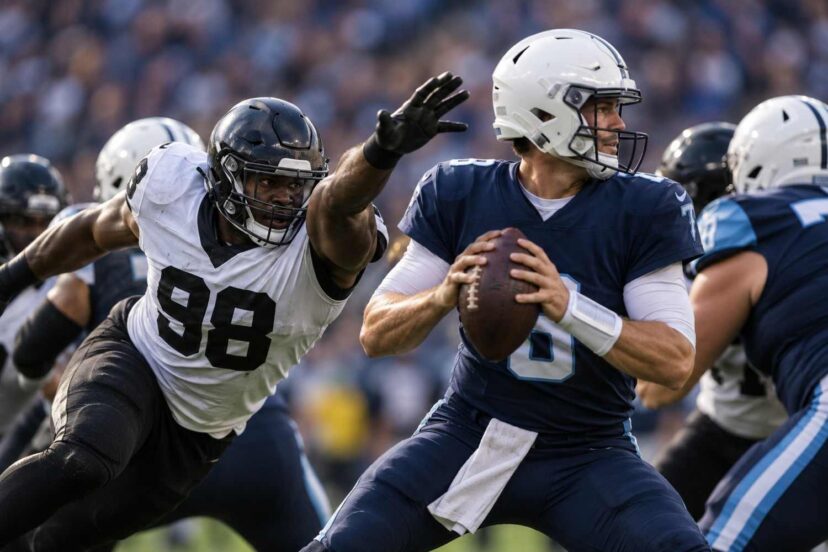
Sacks are one of the easiest ways to judge an NFL pass rush. If a defense recorded five sacks last week, its pass rush probably looks dominant in the box score. If another defense finished with zero sacks, it may appear to have generated little disruption. The problem for bettors is that sack totals don’t always tell the complete story. A defense can repeatedly force a quarterback out of rhythm without bringing him to the ground. NFL pressure rate can provide additional context by helping measure how frequently a pass rush creates pressure rather than focusing only on the plays that end in sacks.
This distinction can be valuable when handicapping NFL games. A defense that consistently generates pressure but hasn’t produced many sacks may be playing better than its recent sack totals suggest. Another defense could have a large number of sacks despite generating pressure less consistently.
Neither situation automatically creates a betting opportunity. Pressure rate is best used alongside offensive-line performance, quarterback tendencies, injuries, game situation, and the sportsbook’s betting line.
What Is NFL Pressure Rate?
Pressure rate attempts to measure how frequently a defense pressures opposing quarterbacks on passing plays or pass-rush opportunities.
The basic concept is straightforward. Instead of simply asking how many sacks a defense recorded, pressure rate asks how frequently the defense disrupted the quarterback.
A simplified calculation might look like this:
Pressure Rate = Pressures ÷ Qualifying Passing Opportunities
Suppose a defense generates 18 pressures over 45 qualifying opportunities.
18 ÷ 45 = 0.400
That would represent a 40% pressure rate under that particular definition.
There is an important complication, however: pressure statistics aren’t necessarily defined identically by every data provider.
What qualifies as a pressure can depend on the source. Providers may track sacks, quarterback hits, hurries, or other forms of disruption, while their definitions of qualifying dropbacks or pass-rush opportunities can also differ.
That means bettors should be careful when comparing pressure statistics.
If one website lists Team A with a 38% pressure rate and another lists Team B at 35%, don’t automatically conclude Team A has the better pass rush if the numbers come from different providers.
Whenever possible, compare teams using the same data source and methodology.
Pressure Rate vs. Sack Rate: What’s the Difference?
The difference between pressure rate and sack rate is central to understanding why pressure statistics can be useful.
A sack is a specific outcome. The quarterback is tackled behind the line of scrimmage on a passing play before getting the pass away.
Pressure covers a broader range of pass-rush disruption.
A defender can beat an offensive lineman, force the quarterback to move, speed up a throw, or otherwise affect the play without recording a sack.
For bettors, there are several ways pressure may affect a passing play even when the quarterback remains upright.
Early throws: A quarterback who feels pressure may release the football before the intended receiver finishes his route. The result could be an incompletion or a shorter gain than the offense intended.
Scrambles: Pressure can force the quarterback to abandon the designed passing play. A mobile quarterback may still gain yardage, but the defense has changed what the offense originally intended to do.
Checkdowns: Instead of waiting for a deeper route to develop, the quarterback may throw to a running back or another short option because pressure is arriving.
Inaccurate passes: Pressure can interfere with a quarterback’s footwork and throwing mechanics, potentially affecting accuracy.
Throwaways: Sometimes the best response to pressure is simply getting rid of the football. The defense doesn’t receive credit for a sack, but it has still contributed to an unsuccessful offensive play.
Turnover opportunities: Pressure can sometimes contribute to rushed decisions, tipped passes, fumbles, or other situations that increase the possibility of a turnover. It is important not to assume that every pressure will create a turnover, however.
The larger lesson is that sacks represent only one possible result of a successful pass rush. A defense can therefore have an effective pass-rushing performance without accumulating a large sack total.
Why NFL Pressure Rate Can Matter for Bettors
Imagine two defenses that each face 40 opponent dropbacks.
Defense A records five sacks but generates only a handful of additional pressures.
Defense B records zero sacks but consistently forces the quarterback to move, throw early, or abandon the original play.
If a bettor looks only at sacks, Defense A appears to have performed much better.
The underlying pass-rush performance may tell a different story.
This is where NFL pressure rate can provide useful context. It allows bettors to examine how consistently a defense creates disruption rather than judging the unit exclusively by whether those pressures happened to become sacks.
It also introduces the idea of pressure-to-sack conversion.
Not every pressure becomes a sack. A quarterback may throw the football before the defender arrives, escape the pocket, or evade the defender.
Over short periods, a defense could convert an unusually high percentage of its pressures into sacks. Another could generate plenty of pressure but struggle to finish those plays.
Those situations are worth investigating because the sack column alone won’t reveal them.
The goal isn’t to predict that sack totals must move in the opposite direction. Instead, bettors can ask whether recent sack production appears consistent with the amount of pressure the defense has actually generated.
How Pressure Can Affect Quarterback Performance
A pressure is only half of the interaction. The quarterback’s response also matters.
Some quarterbacks excel at recognizing pressure and releasing the ball quickly. Others extend plays with mobility. Some hold the ball while waiting for downfield routes to develop, which may provide additional opportunities for defenders to turn pressure into sacks.
That means the same pass rush can produce very different results depending on the opposing quarterback.
Consider a defense with an excellent pressure rate.
Against a quarterback who makes quick decisions and regularly gets the ball out before pressure arrives, that pass rush may generate relatively few sacks.
Against a quarterback who frequently holds the football looking for deep routes, the same defense might have considerably more time to finish its rush.
Mobility introduces another variable.
A mobile quarterback may escape what would have been a sack against a less mobile passer. However, forcing the quarterback out of the pocket can still disrupt the timing and structure of the offense.
For handicappers, evaluating pressure should therefore include both the defense’s ability to create it and the quarterback’s ability to respond to it.
Pass Rush vs. Offensive Line: Evaluating the Matchup
A defense doesn’t generate pressure in a vacuum. Every pass rush is interacting with an offensive line, blocking scheme, quarterback, running backs, tight ends, and offensive play design.
This makes the pass-rush-versus-protection matchup more informative than simply ranking defenses by pressure rate.
A bettor can break the matchup into several components.
Defensive pressure rate provides a starting point. Determine how frequently the defense has disrupted opposing quarterbacks. Look beyond the league ranking and consider whether that production has been consistent.
Offensive pressure rate allowed examines the other side. How frequently has the offense allowed its quarterback to come under pressure? A strong defensive pass rush becomes more interesting when it faces a protection unit that has consistently struggled.
Sack rate adds another layer. Determine how frequently passing opportunities actually result in sacks. Comparing sack production with overall pressure can help identify whether the box score tells the same story as the underlying disruption.
Quarterback tendencies can then help explain how the matchup might play out. Does the quarterback release the football quickly? Does he frequently scramble? Does he hold the ball looking for larger plays? How has he performed when pressured?
The most interesting situations often occur when several factors point in the same direction.
For example, a defense that consistently generates pressure facing an offense that regularly allows it – and a quarterback who frequently takes sacks – may have a particularly favorable pass-rush matchup.
That still isn’t an automatic wager, but it provides information worth incorporating into the overall handicap.
How to Use Pressure Rate When Handicapping NFL Games
Pressure rate becomes more useful when it is part of a repeatable process. Instead of checking the statistic only when it supports a team you already want to bet, evaluate the same factors for both teams.
The following process provides a practical starting point.
Check the Defense’s Pressure Rate
Begin by determining how frequently the defense generates pressure.
Don’t immediately interpret a high ranking as a reason to bet that defense. Look at the actual rate, the sample behind it, and how consistently the defense has generated pressure.
Also consider whether the pressure is created primarily through individual pass-rush talent or heavy blitzing. Those approaches can produce different matchup considerations.
Check the Opponent’s Pressure Rate Allowed
Next, determine how well the offense protects its quarterback.
An excellent pass rush facing an excellent offensive line isn’t the same matchup as that pass rush facing one of the league’s weaker protection units.
Look for overlap between a defensive strength and an offensive weakness.
Compare Pressure With Sack Production
Now examine whether the defense’s sack totals appear consistent with its pressure production.
A team producing plenty of sacks and plenty of pressure has a different profile from one producing many sacks on relatively few pressures.
Likewise, a defense with few sacks shouldn’t automatically be dismissed if it consistently generates pressure.
This is an area where the underlying statistics may provide information that isn’t obvious from the traditional box score.
Evaluate the Quarterback
The quarterback can determine whether pressure becomes a sack, scramble, throwaway, completion, or potentially a big play.
Consider mobility, pocket awareness, decision-making, and how quickly the quarterback generally gets rid of the football.
If available from your preferred statistics provider, performance under pressure can provide additional context.
Check Offensive-Line and Defensive Injuries
Injuries can dramatically change this matchup.
A season-long offensive pressure rate may become less representative if the starting left tackle is unavailable. Losing multiple offensive linemen can have an even greater effect.
The same applies defensively. If a team’s best edge rusher is out, historical pressure numbers include production from a player who won’t participate in the upcoming game.
Always check current personnel before relying heavily on season averages.
Consider Expected Game Situation
Game script can affect pass-rush opportunities.
A team trailing by 17 points in the second half may have to throw frequently. Defenders can become more aggressive when they know the offense is unlikely to run.
A team protecting a lead may therefore have more favorable pass-rushing opportunities than it did earlier in the game.
When handicapping, consider not just which defense is better at generating pressure but also which team is more likely to play from a position that allows its pass rush to attack.
Compare the Matchup With the Betting Line
This is the final and most important step.
Suppose Team A has a major pass-rush advantage over Team B’s offensive line. Team B’s quarterback also struggles when pressured.
That may be a legitimate matchup advantage.
But if Team A is favored by 13 points, bettors still have to decide whether that advantage is large enough to justify the spread.
Finding an advantage and finding betting value aren’t necessarily the same thing.

Can Pressure Rate Help With NFL Point Spread Betting?
Pressure can matter to point spreads because disrupting the quarterback can affect entire possessions.
A sack on third down can end a drive. Pressure that forces an incompletion can accomplish the same thing. A strip sack may provide the offense with excellent field position.
This can be particularly interesting when evaluating underdogs.
Suppose an underdog is weaker overall but possesses an excellent pass rush facing an opponent with offensive-line problems. The underdog may have a way to disrupt the favorite’s offense that isn’t adequately represented by overall team rankings.
Favorites can benefit from pass-rush mismatches as well.
A favorite that builds an early lead may force its opponent into more passing situations, potentially creating additional opportunities for sacks and pressure.
Still, pressure rate shouldn’t be turned into a simple rule such as betting the team with the better pass rush.
The point spread matters. So do the rest of the offensive, defensive, and situational matchup.
Can Pressure Rate Help With NFL Totals?
Pressure statistics can also provide context for Over/Under handicapping, although the relationship isn’t straightforward.
Strong pass-rush performances can contribute to sacks, incompletions, punts, and stalled drives. Those outcomes could reduce scoring.
But pressure can also create turnovers.
A strip sack deep in an opponent’s territory might give the other offense an extremely short field. An interception caused by a rushed throw could produce the same result. Defensive touchdowns can have an even greater effect on scoring.
Game situation matters here as well.
An offense facing frequent pressure might shift toward quicker throws or a more conservative approach. Another may continue attempting aggressive downfield plays.
For totals bettors, pressure should therefore be combined with pace, offensive efficiency, injuries, turnovers, weather, and the posted total rather than being interpreted as an automatic Under indicator.
Pressure Rate and Sack Regression
One of the more interesting applications of pressure statistics is evaluating whether recent sack totals accurately represent the performance of the pass rush.
Suppose a defense generates substantial pressure for several weeks but records very few sacks.
A bettor looking only at the sack column might conclude that the pass rush is ineffective. A closer examination could show that defenders are regularly getting near the quarterback without finishing the play.
Now consider the opposite situation.
A defense has accumulated a large number of sacks despite generating relatively modest overall pressure.
That doesn’t mean its sack production is guaranteed to decline. There may be legitimate reasons for the high conversion rate, including the quality of individual pass rushers or the quarterbacks it has faced.
However, the discrepancy gives bettors something to investigate.
Rather than automatically predicting regression, ask a better question:
Is this team’s sack production supported by how consistently it generates pressure?
If sacks, pressure rate, opponent quality, and matchup characteristics all support the same conclusion, the performance may be more convincing.
If sack totals look exceptional while the underlying pressure production is ordinary, additional caution may be warranted.
Factors That Can Distort NFL Pressure Rate
Like most football statistics, pressure rate needs context. Several factors can make a team’s raw number appear more or less impressive than the underlying performance actually is.
Opponent quality matters because generating pressure against weak offensive lines may be considerably easier than doing so against strong protection units.
Offensive-line injuries can temporarily increase pressure allowed. If several starters return, recent numbers may not accurately represent the current offensive line.
Defensive injuries can have the opposite effect. Losing an elite edge rusher or interior defender may significantly reduce a defense’s ability to create pressure.
Quarterback mobility can change the outcome of pressure. Some quarterbacks can escape defenders who would sack a less mobile passer.
Time to throw is also important. Quick-passing offenses can reduce the time available for defenders to reach the quarterback.
Blitz frequency can influence how a defense generates pressure. A team may create disruption by sending additional rushers, which can also affect coverage behind the blitz.
Game script changes opportunities. Defenses facing teams that must pass repeatedly can attack differently than when the run remains a significant threat.
Finally, sample size matters. One game against an injured offensive line shouldn’t outweigh a much larger body of evidence.
Common Mistakes When Using Pressure Rate for NFL Betting
Pressure statistics can add useful information, but bettors can easily misuse them if they don’t account for context.
One common mistake is treating pressure statistics from every provider as interchangeable. Definitions and tracking methods can differ, so comparisons are more reliable when they come from the same source.
Another mistake is ignoring the quarterback. A pressure-prone offensive line protecting a quarterback who releases the football quickly can produce different results from the same line protecting a quarterback who holds the ball.
Looking only at sacks is precisely the problem pressure rate is designed to help address. Sacks are important, but they don’t represent every successful pass-rush play.
Ignoring opponent quality can also distort conclusions. A defense that generated enormous pressure against several poor offensive lines may not reproduce those results against stronger competition.
Bettors should also avoid overreacting to one game. A six-sack performance can attract attention, but one exceptional result doesn’t necessarily represent a sustainable level of pass-rush production.
Finally, don’t ignore the sportsbook’s price. Identifying a favorable pass-rush matchup doesn’t automatically make the favored team worth laying the points with.
Building Pressure Rate Into an NFL Handicapping Checklist
The best use of pressure rate is as one component of a broader NFL handicapping process.
Start with the defense’s ability to generate pressure and compare it with the offense’s pressure rate allowed. Then evaluate sack production to determine whether the traditional box score supports the underlying pressure numbers.
Next, examine the quarterback. Consider mobility, decision-making, time to throw, and performance when the pocket breaks down.
Check offensive-line and defensive injuries before making any conclusions from season-long statistics. Then consider likely game script and whether one team could be forced into obvious passing situations.
Finally, compare the entire matchup with the sportsbook’s spread, moneyline, or total.
That sequence keeps the focus where it belongs: not on finding the defense with the best statistic, but on determining whether the pass-rush matchup creates an advantage that isn’t fully reflected in the betting number.
Frequently Asked Questions About NFL Pressure Rate
What Is Pressure Rate in the NFL?
Pressure rate measures how frequently a defense generates quarterback pressure relative to a defined number of passing plays, dropbacks, or pass-rush opportunities. The exact formula can vary depending on the data provider.
What Is the Difference Between Pressure Rate and Sack Rate?
Pressure rate measures a broader category of quarterback disruption. Sack rate focuses specifically on plays that result in the quarterback being sacked.
A quarterback can be pressured without being sacked, which is why the two statistics can tell different stories about a pass rush.
Can a Team Have a Good Pass Rush Without Many Sacks?
Yes. A defense can consistently hurry, hit, move, or otherwise disrupt quarterbacks without recording many sacks.
This is one reason bettors may want to look beyond traditional sack totals when evaluating defensive performance.
Does Quarterback Pressure Matter for NFL Betting?
It can provide useful handicapping information, particularly when a strong pass rush faces an offense that struggles in pass protection.
However, pressure rate shouldn’t be used as a standalone betting signal. Quarterback tendencies, injuries, game script, opponent quality, and the sportsbook’s betting line should also be considered.
Conclusion
NFL pressure rate can help bettors look beyond sack totals and develop a more complete understanding of how consistently a defense disrupts opposing quarterbacks. A pass rush doesn’t have to bring the quarterback to the ground to affect a play. Hurries, forced movement, early throws, and other forms of pressure can influence an offense without appearing in the sack column.
The most useful approach is to compare defensive pressure with the opponent’s ability to protect the quarterback, then account for sack rate, quarterback tendencies, injuries, opponent quality, and expected game situation.
Sacks still matter. They simply don’t tell the entire story.
By examining the process that produces those sacks – and the pressures that don’t become sacks – bettors can add another useful layer of information to their NFL handicapping process.
Before You Go…
Get Weekly Winning Angles Delivered to You
Enjoy this article? Join the Core Sports Betting newsletter where we break down actionable strategies, betting angles, and real-game insights.
Some of the concepts we touch on each week can evolve into full handicapping systems – the kind you can test, refine, and potentially build into long-term edges.
Simple. Practical. No fluff.
Proven Sports Betting Courses
Looking to go deeper?
Our step-by-step courses are built around structured systems – not guesses or opinions. Each course has been backtested over a minimum of 10 years, giving you a clear understanding of how the strategy has performed over time.
If you’re serious about improving your process, these courses show you exactly how to approach betting with discipline and structure.
Free Betting Calculators to Sharpen Your Edge
Want to make smarter, faster decisions?
Our free tools help you quickly calculate odds, payouts, and true value — without the guesswork.
Try these popular calculators:
- Moneyline Calculator
- Parlay Calculator
- No-Vig Odds Calculator (Find True Odds)
- Kelly Criterion Calculator
→ Visit the Betting Tools Hub to access all calculators
Like this article? Pin it on Pinterest!

More to Explore