When handicapping an NBA game, it is easy to focus on familiar statistics such as points…
College Football Explosiveness: How IsoPPP Can Help Handicapping
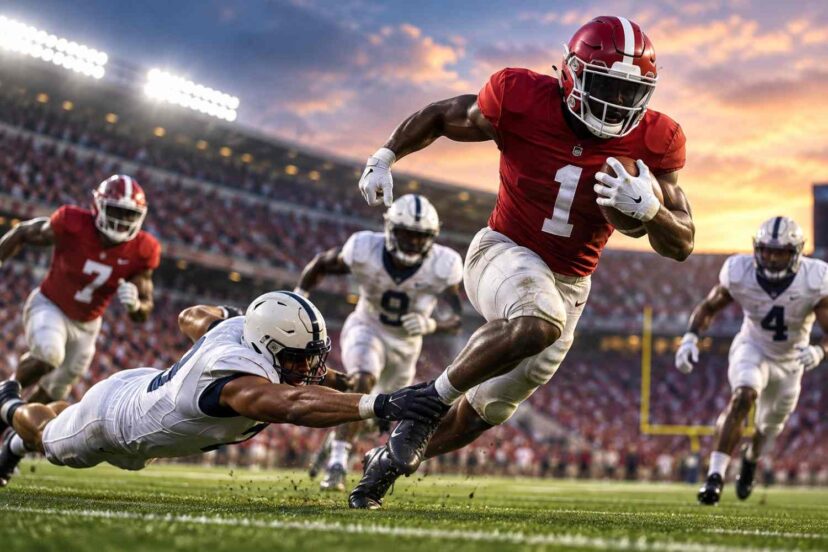
College football offenses can reach the same statistical destination in very different ways. One team might accumulate 450 yards through a series of efficient five-, eight-, and 12-yard gains, while another reaches 450 yards by producing several enormous plays mixed with unsuccessful possessions. Traditional box-score statistics may make the offenses look similar even though their styles are considerably different. College football explosiveness can help bettors recognize this distinction, and IsoPPP is one metric that has been used to measure how much value an offense creates when its plays are successful.
For handicappers, understanding explosiveness can provide additional context when evaluating point spreads, totals, and individual matchups. An offense capable of generating large gains can change a game quickly, while a defense that regularly prevents those plays may force an opponent to operate differently.
IsoPPP should not be viewed as a standalone betting system, however. Like most advanced statistics, it is most useful when combined with efficiency, opponent quality, personnel, pace, and the sportsbook’s betting line.
What Is Explosiveness in College Football?
Explosiveness generally describes a team’s ability to create large gains.
A 60-yard touchdown obviously has a much greater impact on a game than a six-yard gain, even though both plays could be considered successful depending on the down and distance. Explosive offenses possess the ability to create those high-impact plays with enough regularity that defenses must account for the possibility of giving up significant yardage at once.
There are several ways analysts can attempt to measure explosiveness. One simple method is counting plays that exceed a predetermined yardage threshold, such as runs of 10 or more yards or passes of 20 or more yards. This can provide useful information, but it also has limitations.
Suppose two offenses each record five passes of at least 20 yards.
Team A’s gains are 21, 22, 23, 24, and 25 yards. Team B’s gains are 21, 25, 37, 52, and 70 yards.
Simply counting 20-yard plays would give each offense five explosive passes. Yet Team B produced substantially more yardage and scoring potential from its biggest plays.
This is one reason more advanced explosiveness measurements can be useful. Rather than simply asking how many explosive plays occurred, a metric can attempt to determine the magnitude of successful plays.
That leads us to IsoPPP.
What Is IsoPPP?
IsoPPP stands for Isolated Points Per Play. The metric is associated with Bill Connelly’s college football analytics work and is based on the concept of Equivalent Points, which assigns value to field position based on the expected scoring value associated with reaching different areas of the field.
The “isolated” portion is especially important.
IsoPPP focuses on successful plays, separating explosiveness from the question of how consistently an offense succeeds.
This distinction allows a handicapper to consider two separate questions:
How often does an offense produce successful plays?
And:
How damaging are those plays when the offense succeeds?
The first question is associated with efficiency and Success Rate. The second is where IsoPPP enters the picture.
Imagine an offense that repeatedly gains enough yardage to remain ahead of the chains but rarely generates huge plays. It could have strong efficiency numbers without being particularly explosive.
Another offense might produce several unsuccessful plays followed by a 50-yard completion. Its consistency may be relatively poor, but its successful plays can be extremely damaging.
IsoPPP helps distinguish between these offensive profiles.
One caution is important for bettors researching the statistic. College football analytics have evolved over time, and different websites may use different terminology or methods for measuring explosiveness. Some resources use IsoPPP, while others emphasize explosive-play rates, yards per successful play, or other measurements.
Before comparing numbers from two sources, make sure they are measuring the same thing.
Why College Football Explosiveness Matters for Bettors
Explosive plays can transform games.
An offense that needs 10 or 12 plays to score a touchdown has more opportunities for something to go wrong. A penalty, sack, dropped pass, tackle for loss, or turnover can end the possession before points are scored.
An explosive offense may be capable of avoiding that problem by covering a substantial portion of the field with one play.
Consider two hypothetical teams starting at their own 25-yard line.
Team A methodically moves downfield with several short gains. It eventually reaches the opponent’s 30-yard line but takes a sack on third down and misses a field goal.
Team B begins from the same location and completes a 55-yard pass on its second play. It scores a touchdown shortly afterward.
Team A may have been efficient for most of its drive, but Team B created more scoreboard value from one enormous play.
For bettors, college football explosiveness can help identify teams capable of changing field position or scoring quickly even when they aren’t consistently moving the chains.
That doesn’t mean explosive offenses are automatically better betting opportunities. Their ability to generate large gains needs to be considered alongside their consistency and the opponent’s ability to prevent those plays.
IsoPPP vs. Success Rate: Understanding the Difference
IsoPPP becomes considerably more informative when evaluated alongside Success Rate.
Success Rate is designed to measure efficiency by determining how frequently an offense gains enough yardage to consider a play successful based on down and distance. IsoPPP approaches the offense from another direction by evaluating the magnitude of successful plays.
Combining the two concepts can produce several general offensive profiles. These aren’t betting systems, but they can help bettors understand what type of offense they are evaluating.
High Success Rate + High Explosiveness: This is an attractive offensive combination. The team consistently produces successful plays while also generating substantial gains when successful. A defense facing this type of offense may have difficulty getting off the field while remaining vulnerable to big plays.
High Success Rate + Low Explosiveness: This offense may consistently stay on schedule but rely on sustained drives rather than huge gains. The offense could still be very effective, but it may need to execute successfully for more plays before reaching the end zone.
Low Success Rate + High Explosiveness: This is a potentially volatile offense. It may struggle on a play-to-play basis but remain dangerous because one or two big plays can change the game. Bettors need to decide whether the opposing defense is likely to allow those opportunities.
Low Success Rate + Low Explosiveness: This is generally a less desirable offensive profile. The team struggles to consistently generate successful plays and doesn’t compensate with many high-impact gains.
The important lesson is that efficiency and explosiveness describe different characteristics.
Looking at both can provide a more complete picture than using either statistic alone.
Offensive IsoPPP vs. Defensive Explosiveness
Just as bettors shouldn’t evaluate an NBA team’s free throw rate without considering the opponent’s ability to prevent free throws, offensive explosiveness needs defensive context.
Suppose Team A has an excellent offensive IsoPPP and consistently generates substantial gains on successful plays. That tells us something useful about Team A.
But now consider two possible opponents.
Team B has been excellent at limiting explosive plays.
Team C has repeatedly surrendered large gains.
Team A’s offensive explosiveness could have very different implications in those two matchups.
The matchup against Team C creates statistical overlap: an offense capable of producing big plays is facing a defense that has demonstrated difficulty preventing them.
This is where college football explosiveness can become more useful for handicapping. The goal isn’t simply to rank every offense from most explosive to least explosive. Instead, bettors can look for situations where an offensive strength aligns with a defensive weakness.
The reverse situation deserves attention as well.
If an offense depends heavily on explosive plays but faces a defense that rarely allows them, the offense may be forced to sustain longer drives. If that offense also has a mediocre Success Rate, taking away its primary source of big gains could create problems.
That is much more informative than simply saying one team ranks 12th in explosiveness and the other ranks 35th.
How to Use IsoPPP When Handicapping College Football
A structured process can make advanced statistics more useful. Rather than looking at IsoPPP only after deciding which team you want to bet, incorporate explosiveness into the same evaluation for both sides.
The following process provides a starting point. Each step adds another layer of context rather than being treated as an independent reason to make a wager.
Evaluate Offensive Explosiveness
Start by examining how much value each offense generates from its successful plays.
Don’t immediately interpret a high number as a reason to bet the team. Instead, determine what the statistic tells you about how the offense moves the football.
Does the team regularly create big passing plays? Is the explosiveness generated primarily through the running game? Does one exceptional player account for much of it?
Understanding the source of the number matters.
Examine Defensive Explosiveness Allowed
Next, look at the opposing defense.
The key question is whether the defense has consistently limited big plays or has been vulnerable to them.
If an explosive passing offense faces a secondary that has repeatedly surrendered long completions, that matchup deserves additional attention.
The same principle applies to rushing explosiveness.
Add Success Rate
Now determine whether the offense is both explosive and efficient or primarily dependent on big plays.
A low-efficiency, high-explosiveness offense presents a different challenge from an offense that excels in both categories.
This can be particularly useful when evaluating an underdog. An underdog that struggles to consistently move the ball may still possess a realistic path to scoring if it can create several explosive plays.
Consider How the Teams Create Explosive Plays
Team-level statistics can hide important details.
Suppose a team’s excellent explosiveness is driven primarily by deep passes, but the upcoming opponent’s biggest defensive weakness is stopping the run. The overall numbers may suggest a favorable matchup when the actual styles don’t align as neatly.
Look beneath the team ranking whenever possible.
Account for Personnel
College football rosters can change significantly because of injuries, quarterback changes, suspensions, transfers, and depth-chart movement.
If the receiver responsible for many of a team’s explosive plays is unavailable, season-long statistics may overstate the explosiveness of the current offense.
The quarterback position is particularly important. A backup quarterback may have a completely different playing style and ability to push the ball downfield.
Consider Opponent Quality
Statistics accumulated against weak opponents shouldn’t automatically be treated the same as numbers generated against strong defenses.
Examine who the team has played and whether its explosive production remained effective against comparable opponents.
Compare Everything With the Betting Line
This final step is essential.
Suppose you identify a strong offensive explosiveness advantage for Team A. Team A also has the better Success Rate and appears to match up well against Team B’s defense.
That still doesn’t tell you whether Team A is a good bet.
If Team A is favored by 24 points, the sportsbook is already requiring bettors to pay a substantial price for its superiority.
The question isn’t simply which team has the advantage.
The question is whether that advantage is greater or smaller than what is reflected in the betting line.

Using Explosiveness for College Football Point Spreads
Explosiveness can be interesting on both sides of a point spread.
For favorites, the ability to create big plays can help generate separation. An explosive offense can turn a competitive game into a multi-score advantage quickly, particularly when the opposing defense has demonstrated difficulty limiting big gains.
For underdogs, explosiveness can offer a potential path toward remaining competitive.
Imagine an underdog that is clearly less efficient than the favorite. If the underdog is capable of generating several long touchdowns, it may not need to consistently win lengthy drives to score enough points to challenge the spread.
There is also additional uncertainty with big-play-dependent offenses.
An offense that relies heavily on explosive plays may look excellent when it hits three long touchdowns but ineffective when those opportunities disappear. That can create more game-to-game variability than an offense capable of consistently producing successful plays.
For spread handicapping, bettors should therefore consider both a team’s big-play potential and how dependent it is on those plays.
Can IsoPPP Help With College Football Totals?
Explosiveness also has an obvious connection to scoring, making it potentially relevant when handicapping Over/Under totals.
If two explosive offenses face defenses susceptible to big plays, the matchup may contain ingredients that support higher scoring. Long touchdowns reduce the amount of time and number of plays needed to put points on the board.
However, high explosiveness should never automatically mean betting the Over.
Totals involve many additional factors.
Pace determines how many possessions and plays may occur. Success Rate influences whether offenses can sustain drives when big plays aren’t available. Finishing drives can affect whether scoring opportunities become touchdowns or field goals. Turnovers can either eliminate scoring opportunities or create short fields.
Weather can also be particularly relevant in college football. Strong wind, heavy rain, or other difficult conditions may affect an offense that depends heavily on downfield passing.
Most importantly, bettors must consider the posted total.
A matchup can have excellent offensive conditions and still offer little value on the Over if the sportsbook has already posted an extremely high number.
Why Sample Size and Opponent Quality Matter
College football presents a particular challenge for advanced-stat handicapping because teams play relatively few games compared with professional basketball or baseball.
Early-season numbers can be especially misleading.
Suppose a team opens the season against an overmatched opponent and produces touchdown plays of 75, 62, and 55 yards. Its explosiveness numbers may look exceptional after one game.
That doesn’t necessarily mean the offense will produce similar results against a strong conference defense.
A handful of huge plays can have an outsized impact on small samples. As the season progresses, bettors gain more information, but strength of schedule remains important.
This is why advanced statistics shouldn’t be interpreted without context.
When reviewing IsoPPP or another explosiveness metric, examine the opponents behind the numbers. Determine whether the offense has demonstrated big-play ability against several types of defenses or accumulated much of its production against weaker competition.
Recent performance can also be informative, but avoid choosing an arbitrary three-game window simply because it supports the wager you already prefer.
Common Mistakes When Using IsoPPP for Betting
IsoPPP can provide useful information, but advanced statistics can create a false sense of precision if they are used incorrectly. Bettors should be aware of several common mistakes before incorporating explosiveness into their handicapping.
Treating IsoPPP as a betting system is the biggest problem. A team with better explosiveness numbers isn’t automatically the better wager. The betting line, opponent, and many other variables still matter.
Ignoring Success Rate can also create an incomplete picture. A highly explosive offense may be inconsistent between its big plays. Knowing both characteristics helps explain the offense more accurately.
Looking only at offense ignores the matchup. An explosive offense facing an elite big-play defense is different from that same offense facing a defense that repeatedly allows long gains.
Overreacting to small samples can be particularly dangerous. Several enormous plays can significantly affect explosiveness measurements over a limited number of games.
Ignoring opponent strength can make a team appear better than it is. Production against weak defenses doesn’t necessarily translate directly to stronger competition.
Ignoring personnel changes can make historical statistics less relevant. The absence of a quarterback, running back, receiver, or key offensive lineman can change how an offense operates.
Finally, forgetting the betting price defeats the purpose of handicapping. Correctly identifying the better team or a favorable matchup doesn’t guarantee that the sportsbook’s spread offers value.
Building Explosiveness Into a College Football Handicapping Process
The ultimate goal isn’t to find one statistic capable of predicting games. It is to build a collection of measurements that describe different aspects of the matchup.
A bettor could begin with efficiency measurements such as Success Rate and then add explosiveness to understand what happens when each offense succeeds. Defensive versions of those statistics can reveal how effectively the opponent prevents the same outcomes.
From there, other factors can be added: pace, finishing drives, havoc, turnovers, injuries, quarterback play, rushing and passing matchups, opponent quality, weather, and home-field considerations.
Only after developing an overall view of the matchup should the bettor compare that assessment with the point spread, moneyline, or total.
Keeping records can make this process even more useful. If you consistently document the statistics and reasoning behind wagers, you can eventually evaluate whether explosiveness actually improves your handicapping rather than assuming that it does.
Conclusion
College football explosiveness provides a different perspective from traditional statistics such as total yards and points per game. IsoPPP can help bettors examine the magnitude of a team’s successful plays, while Success Rate can provide additional information about how consistently those successful plays occur.
The most useful application isn’t simply finding the team with the better IsoPPP. Bettors can compare offensive explosiveness with the opposing defense, determine whether a team relies heavily on big plays, evaluate personnel and opponent quality, and then consider how those factors relate to the sportsbook’s line.
A team capable of creating 50-yard touchdowns can change a game quickly, but no advanced statistic eliminates uncertainty. IsoPPP is best viewed as another tool for understanding how a matchup may unfold – and whether the available betting number provides an opportunity worth considering.
Before You Go…
Get Weekly Winning Angles Delivered to You
Enjoy this article? Join the Core Sports Betting newsletter where we break down actionable strategies, betting angles, and real-game insights.
Some of the concepts we touch on each week can evolve into full handicapping systems – the kind you can test, refine, and potentially build into long-term edges.
Simple. Practical. No fluff.
Proven Sports Betting Courses
Looking to go deeper?
Our step-by-step courses are built around structured systems – not guesses or opinions. Each course has been backtested over a minimum of 10 years, giving you a clear understanding of how the strategy has performed over time.
If you’re serious about improving your process, these courses show you exactly how to approach betting with discipline and structure.
Free Betting Calculators to Sharpen Your Edge
Want to make smarter, faster decisions?
Our free tools help you quickly calculate odds, payouts, and true value — without the guesswork.
Try these popular calculators:
- Moneyline Calculator
- Parlay Calculator
- No-Vig Odds Calculator (Find True Odds)
- Kelly Criterion Calculator
→ Visit the Betting Tools Hub to access all calculators
Like this article? Pin it on Pinterest!


More to Explore