Golf tournaments present bettors with a challenge that is different from many other sports. The playing…
NHL Puckline Strategy for Underdogs: How to Bet NHL Puckline Underdogs Profitably

If you’ve been around hockey betting long enough, you’ve probably noticed that NHL underdogs can be sneaky profitable. Not always on the moneyline, but often on the puckline – the spread that typically gives the underdog +1.5 goals. That extra goal and a half can turn what looks like a risky bet into a strong value play. But like any strategy, success depends on knowing when to use it and when to pass.
In this article, we’re going to break down how to bet NHL puckline underdogs profitably. You’ll see why the puckline gives smart bettors an edge, how to evaluate games where the dog has a better chance to cover, and the exact step-by-step process for making consistent, profitable wagers. By the end, you’ll understand that betting NHL underdog pucklines isn’t about gambling blindly – it’s about using information, stats, and discipline to tilt the odds in your favor.
What Is the NHL Puckline and Why It Matters
Before diving into strategies, let’s make sure we’re clear on the basics. The puckline in NHL betting works like the spread in football or basketball, but it’s nearly always set at +1.5 goals for the underdog and -1.5 goals for the favorite.
- If you take the underdog +1.5, your bet wins if they win the game outright or lose by exactly one goal.
- If you take the favorite -1.5, your bet wins only if they win by two or more goals.
This is why underdogs are so appealing on the puckline. Even strong favorites often win games by only one goal, meaning the underdog covers. In fact, many NHL seasons see underdogs covering the puckline in more than 50% of games.
When you learn how to bet NHL puckline underdogs profitably, you’re taking advantage of the natural parity in hockey, where games are often closer than oddsmakers project.
Why Underdogs Can Have Value on the Puckline
Hockey is a sport of fine margins. A hot goalie, a lucky bounce, or a penalty kill can swing outcomes dramatically. Unlike basketball where talent gaps are more obvious, NHL games frequently come down to one-goal differences.
This is why the puckline has inherent value: you’re essentially buying insurance on close games. The key is spotting situations where the dog has a strong chance to keep things tight.
Some scenarios where underdogs tend to perform well on the puckline:
- Divisional matchups: Familiarity leads to closer contests.
- Teams with elite goaltending: A hot goalie can neutralize a high-powered offense.
- Back-to-back fatigue for the favorite: Tired legs often lead to tighter games.
- Low-scoring environments: Games projected at 5.5 goals or less tend to stay within one.
When you build a system around these situations, you start to see how to bet NHL puckline underdogs profitably rather than relying on gut feelings.
Key Factors to Analyze Before Betting Puckline Underdogs
Knowing the theory is one thing. Putting it into practice means studying the right stats and angles before placing a bet. Here are the factors that matter most – and how to use them.
- Goaltending Matchups
Goaltending is the great equalizer in hockey. A weak team can still stay competitive if their goalie is standing on his head. Before betting the puckline, check the starting goalies and their recent form.
- Look at save percentage over the last 5–10 games.
- Check if they’ve faced high shot volumes and still produced strong numbers.
- Watch for goalies returning from injury who may not be sharp.
If the underdog has a goalie playing at or above league average, their +1.5 line gains huge value.
- Advanced Metrics
The NHL has plenty of advanced stats that give you insight beyond wins and losses. Two of the most useful for puckline betting are Corsi (shot attempt differential) and expected goals (xG).
- If an underdog consistently posts strong possession numbers (Corsi close to or above 50%), they’re more likely to keep games close.
- Teams with high defensive xG ratings can limit chances, even against elite offenses.
Sites like Natural Stat Trick or MoneyPuck provide free advanced data to help you spot hidden value. This is a major step in how to bet NHL puckline underdogs profitably.
- Schedule and Fatigue
The NHL is grueling, with teams playing three or four games in a week, often across time zones. Favorites playing the second night of a back-to-back are vulnerable to letting underdogs hang around.
Check:
- Who traveled further?
- Who had fewer rest days?
- Are there injuries piling up?
A fresh underdog vs. a fatigued favorite is an ideal puckline opportunity.
- Head-to-Head Matchups
Some teams simply play each other tight. Rivalries and divisional familiarity often lead to one-goal games. Historical matchup data can uncover reliable puckline angles.
For example, if a team has covered the puckline in 7 of their last 9 meetings against a favorite, that trend is worth noting.

Step-by-Step Puckline Underdog Betting Strategy
Now that you know the key factors, let’s put it all together in a structured process. Here’s a step-by-step method you can use to consistently find strong bets.
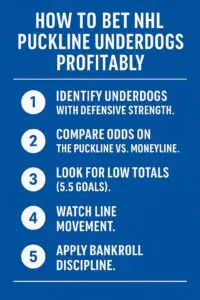
Step 1: Identify Underdogs with Defensive Strength
Start by scanning the schedule for games where the underdog has a solid goalie or defensive system. This narrows down your focus.
Step 2: Compare Odds on the Puckline vs. Moneyline
Check if the puckline odds offer value. For example, if an underdog is +160 moneyline but -190 at +1.5, the puckline might be too expensive. You want reasonable juice, typically -120 to -150.
Step 3: Look for Low Totals (5.5 Goals)
Books set totals low when they expect a defensive battle. These games are typically great for puckline underdogs. Fewer goals mean fewer blowouts.
Step 4: Watch Line Movement
If the puckline or total shifts late, it could signal sharp bettors backing the dog. For example, if an underdog moves from +1.5 (-120) to -135, that’s strong market support.
Step 5: Apply Bankroll Discipline
Don’t chase losses or vary bet sizes wildly. A flat-betting approach (same unit size per wager) is best for puckline plays. Consistency is how you grind long-term profit.
By following these steps, you’re not just gambling—you’re applying a repeatable system for how to bet NHL puckline underdogs profitably.
Common Mistakes to Avoid
Even the best strategy falls apart if you make careless errors. Here are the biggest mistakes puckline bettors make – and how to avoid them.
- Betting Every Underdog
Not all dogs are worth backing. Only bet when the factors line up: strong goalie, good value odds, favorable schedule. - Ignoring the Juice
If the puckline is priced at -200, it’s rarely worth the risk. Always check the risk/reward. - Chasing Losses
Don’t double your bet size after a loss. Bankroll management is key to long-term profit.
By steering clear of these pitfalls, you’ll dramatically improve your chances of winning over time.
Conclusion
Betting NHL underdogs on the puckline isn’t about luck – it’s about identifying the right spots where value exists. Goaltending, advanced stats, scheduling, and matchup history all play a role in spotting profitable opportunities. When you apply discipline and follow a step-by-step process, you can tilt the odds in your favor.
In short, if you want to know how to bet NHL puckline underdogs profitably, the key is preparation, patience, and sticking to a system. Start tracking your bets today, refine your approach, and you’ll discover that puckline underdogs can be one of the most reliable plays in hockey betting.
Before You Go…
Get Weekly Winning Angles Delivered to You
Enjoy this article? Join the Core Sports Betting newsletter where we break down actionable strategies, betting angles, and real-game insights.
Some of the concepts we touch on each week can evolve into full handicapping systems – the kind you can test, refine, and potentially build into long-term edges.
Simple. Practical. No fluff.
Proven Sports Betting Courses
Looking to go deeper?
Our step-by-step courses are built around structured systems – not guesses or opinions. Each course has been backtested over a minimum of 10 years, giving you a clear understanding of how the strategy has performed over time.
If you’re serious about improving your process, these courses show you exactly how to approach betting with discipline and structure.
Free Betting Calculators to Sharpen Your Edge
Want to make smarter, faster decisions?
Our free tools help you quickly calculate odds, payouts, and true value — without the guesswork.
Try these popular calculators:
- Moneyline Calculator
- Parlay Calculator
- No-Vig Odds Calculator (Find True Odds)
- Kelly Criterion Calculator
→ Visit the Betting Tools Hub to access all calculators
Like this article? Pin it on Pinterest!

More to Explore